Acadia Astrophotography 2026: Bortle 2 Skies, Milky Way & Z6II Settings
Acadia is Bortle Class 2 — one of the darkest skies on the US East Coast, where the Milky Way rises straight out of the Atlantic. Nikon Z6II settings, a 2026 Milky Way calendar with new moon dates, and the 3 best shooting locations from Otter Cliff to Little Hunter's Beach.
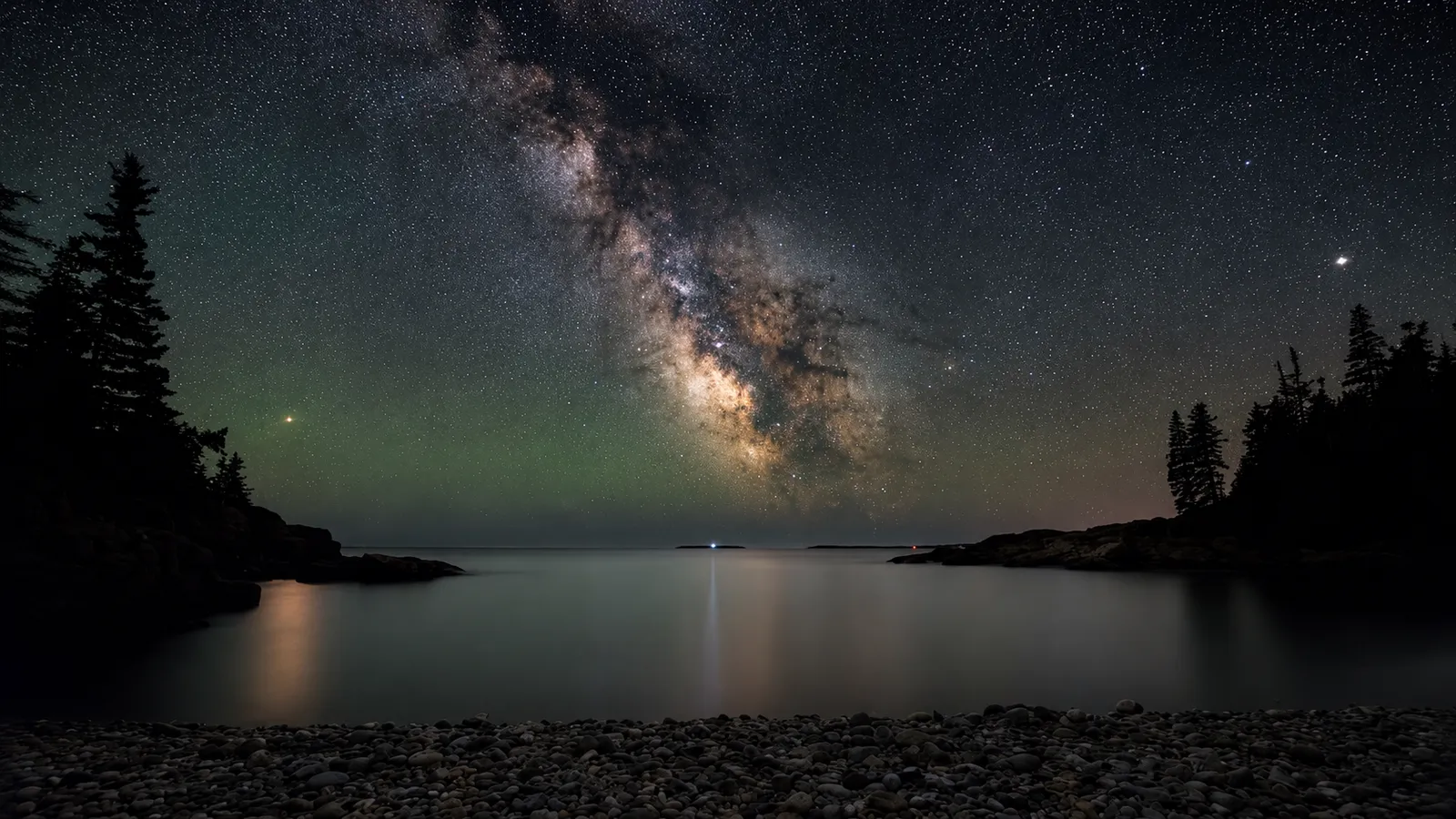
Table of Contents
Stand at Otter Cliff on a moonless July night and the Milky Way rises straight out of the Atlantic. Not a faint smudge — a bright band of silver climbing from the sea-level horizon through the whole height of the sky, with nothing but open ocean and the sound of surf below you.
That's Bortle Class 2 darkness, and the remarkable thing is where it is: on the densely populated East Coast, within a day's drive of 50 million people. Almost nowhere else east of the Mississippi gives you sky this dark over a horizon this clean. This guide covers the three best places to shoot it, the exact Nikon Z6II settings, and a 2026 calendar built around the new moons.
📋 For trail info, seasonal strategy, Cadillac Mountain reservations, and trip logistics, see the Acadia Complete Guide. This article is purely about the night sky.
Dark Sky Data
Acadia rates Bortle Class 2 — a rural-dark sky, and one of the darkest you'll find anywhere in the Northeast. It's not a certified International Dark Sky Park: the park and the surrounding towns have been working toward that since 2009, with lighting ordinances and the annual Night Sky Festival, but the formal designation isn't in place. The darkness, though, is real and measured.
Bortle Class: 2 — rural-dark, among the darkest skies in the Northeast US
DarkSky Certification: Not certified, but active dark-sky lighting practices are in place park-wide
Darkest sites: the southeast shore — Otter Cliff, Little Hunter's Beach, the Ocean Path — where the horizon is open ocean to the south and east
Light pollution: Bangor (~45 miles NW) throws a minor dome to the north-northwest. Face south, southeast, or east and you're looking at clean, dark ocean horizon.
What Bortle 2 actually looks like: the Milky Way shows obvious texture and dark dust lanes to the naked eye, Andromeda is a visible smudge overhead without binoculars, and once your eyes adapt you can pick your way across open granite without a headlamp. Most East Coast photographers have never had sky this dark within a day's drive.
Milky Way Visibility Calendar
At Acadia's latitude (~44.3°N), the galactic core rises in the southeast, crosses through due south, and sets in the southwest. It tops out around 25° above the horizon — not high, which means you want a clear view to the south, and it means foreground matters more here than it does in the desert Southwest. That's the good news, not the bad: Acadia's southeast-facing coast gives you rocky shoreline and ocean reflections to anchor a low core, with zero light pollution in that direction.
Month | Core Visible | Hours/Night | Best Window | Notes |
|---|---|---|---|---|
January | No | — | — | Winter Milky Way arch overhead — Cassiopeia and Perseus, stunning at Bortle 2 |
February | No | — | — | Coldest, clearest nights; winter arch; great for star trails |
March | Marginal | ~1 hr pre-dawn | 4–5 AM | Core just clearing the horizon before twilight |
April | Yes | ~2–3 hrs | 3–5 AM | Window growing; Precipice closed (falcons); spring fog risk |
May | Yes | ~3–4 hrs | 1–4 AM | Good window; cold nights; park much quieter than summer |
June | Yes | ~4–5 hrs | 10 PM–2 AM | Strong month — core up before midnight, warm dark hours |
July | Yes | ~5–6 hrs | 9:30 PM–2 AM | Best month of the year — longest dark window, warmest nights |
August | Yes | ~4–5 hrs | 9 PM–1 AM | Excellent — core sets earlier; Perseid meteors peak Aug 11–13 |
September | Yes | ~3 hrs | 8:30–11 PM | Core brief but park quieter; Night Sky Festival month |
October | Yes | ~1–2 hrs | 7:30–9:30 PM | Core low and brief; fall foliage as foreground is extraordinary |
November | No | — | — | Winter arch returns; park nearly empty |
December | No | — | — | Statistically clearest nights; no core, but star trails and the winter arch |
One honest caveat about timing: Acadia is one of the foggiest stretches of the East Coast, and the fog is thickest from June through early July — exactly when the dark window is longest. A perfect new moon does you no good if the coast is socked in. July still wins on dark hours, but September and early October trade a shorter core window for noticeably clearer, drier skies and far lower fog odds. If your dates are flexible and you're chasing a guaranteed clear night more than maximum core, the early-fall new moons are the safer bet. Always check the marine forecast, not just the cloud forecast — coastal fog rolls in independent of the sky inland.
2026 new moon dates for peak months:
June 15 — good window; core up by 10 PM.
July 14 — the best dark-sky window of 2026 at Acadia. Core rises around 9:30 PM and stays up until astronomical twilight near 3:30 AM. Warmest nights, lowest fog odds. Book this one early.
August 12 — new moon lands right on the Perseid meteor peak (Aug 11–13), so the opening 3–4 hours after twilight can give you meteors over the core. (There's a total solar eclipse that day too, but its path is over Greenland, Iceland, and Spain — Acadia sees nothing of it, and it doesn't affect the night either way.)
Best Shooting Locations
One Acadia-specific thing to plan around: the tide. Several of these spots are tidal, so check a tide chart alongside the moon phase. Low tide opens up beach foreground and tide pools and keeps your footing dry; high tide can cut off beach access and put you on slick, wet rock in the dark.
1. Otter Cliff & Otter Point
This is the signature Acadia shot. Otter Cliff rises about 60 feet straight out of the Atlantic, with angular granite and a wide-open ocean horizon to the south and southeast. When the core rises from the water in June and July, it's rising into clean, dark sky — there's nothing between you and open ocean.
Park at the Otter Cliff pull-off on Park Loop Road (room for about 15 cars); it's under a five-minute walk to the edge. Scout it in daylight first — the cliff edges are unguarded and the rock is irregular, and walking out blind in the dark is how accidents happen. The Ocean Path between Otter Cliff and Otter Point gives you about a mile of varied coastal compositions: angular granite, tide pools, natural archways. Red headlamp only.
Best season: July and August for the core, November through January for the winter Milky Way arch over the same ocean horizon.
2. Little Hunter's Beach
Less famous than Otter Cliff and arguably more photogenic. Where Otter Cliff is sharp and angular, Little Hunter's is smooth — a beach of rounded cobblestones the ocean has polished over thousands of years. That texture against a chaotic sky is a striking contrast, and the cliff on the south end gives you elevated views out past Baker Island Lighthouse on the horizon.
It's a small, easy-to-miss roadside pull-off on Park Loop Road, parking for about six cars, and the scramble down to the beach is steep, and you'll want to time it near low tide for the cobblestone foreground and safe footing — definitely one to set up before dark. Stake out your composition in the last of the light and be ready before astronomical twilight ends.
Best season: July and August. The cobblestone foreground under the core rising from the southeast makes this the most visually unusual location in the park.
3. Seawall / Bass Harbor Head Lighthouse
The Quiet Side gets far less foot traffic, and Seawall rewards the detour. The Seawall Picnic Area on ME-102A sits on pink granite shoreline with views south and southwest, and parking is plentiful and free. During the September Night Sky Festival, this is where the main Star Party happens — the best-organized stargazing event on the East Coast.
Bass Harbor Head Lighthouse sits about a mile east, one of the most photographed scenes in Maine. It isn't a lit beacon at night, but its silhouette against the stars is a strong anchor — scout the angle from the rocks below in daylight.
One caveat: Seawall faces southwest, not southeast. The core rises in the southeast, so here you'll catch it later in its arc, lower and toward the south. That makes Seawall better for the core's transit position than its rising — but for the Festival crowd, it's the most accessible dark sky in the park.
Nikon Z6II Settings
The Z6II is one of the strongest mirrorless bodies for this work — the back-illuminated sensor handles high ISO cleanly, and paired with the fast 14-24mm f/2.8 you have a lot of light-gathering headroom. At Bortle 2 you don't need to push hard: f/2.8 lets you hold ISO at 3200 and still get a bright, clean core.
500-rule shutter limits (full-frame):
14mm: 500 ÷ 14 = 35 seconds max — but use 20–25s for sharper stars on the 24MP sensor
20mm: 25 seconds
24mm: 20 seconds
Start near these limits, then zoom to 100% on a bright star and shorten until the stars are clean points.
Scenario | ISO | Aperture | Shutter | White Balance | Lens |
|---|---|---|---|---|---|
Milky Way wide field | 3200 | f/2.8 | 20–25s | 3800–4000K | NIKKOR Z 14-24mm f/2.8 S @ 14mm |
Deep sky / Andromeda (tracked) | 1600–3200 | f/1.8–2.8 | 60–120s | 3800K | NIKKOR Z 85mm f/1.8 S |
Star trails (interval stack) | 800 | f/2.8 | 30s × 200–400 frames | 3800K fixed | NIKKOR Z 14-24mm f/2.8 S |
Foreground blend (twilight) | 800 | f/4 | 2–4 min | 4000K | NIKKOR Z 14-24mm f/2.8 S |
The 14-24mm f/2.8 is the wide lens to build around here — that extra stop over an f/4 zoom is exactly what you want for a low coastal core. For tight deep-sky targets like Andromeda or the Double Cluster, the 85mm f/1.8 on a star tracker opens up long, detailed exposures you can't get handheld at wide angle.
Z6II-specific tips:
Long Exposure NR: OFF. It takes as long as the exposure itself to process, and you'll lose half your shooting window waiting. Stack frames in post instead.
IBIS/VR: OFF on tripod. In-body stabilization adds micro-vibration when the camera's already stable. Turn it off before you start.
Focus manually with 10× live view. Autofocus fails at night. Zoom to 10×, find a bright star, and turn the ring until it's the smallest point possible. Check it on a second star.
2-second timer or remote release. Pressing the shutter shakes the camera enough to smear stars at 20+ seconds. Use the timer or a Nikon MC-DC2 cable release.
Blend a twilight foreground. Acadia's rock and the sky need different exposures. Shoot a longer foreground frame (ISO 800, f/4, 2–4 min) while there's still some twilight, then blend it with your Milky Way frames in Lightroom or Photoshop.
No light painting. The NPS prohibits shining light on the rock formations here, and rangers enforce it. Keep light low, red, and pointed at the ground.
What to Photograph (Deep Sky Objects)
At Bortle 2, you can see targets most photographers only read about — described here as they actually look, not as catalog entries.
The Sagittarius Star Cloud is the dense, bright patch just above the southern horizon in July — the thickest-looking part of the whole Milky Way. To the naked eye at this darkness it reads as a pool of silver noticeably brighter than the band around it, and a single 20-second frame at ISO 3200 picks it up cleanly.
The Andromeda Galaxy rises in the northeast through late summer and fall, visible to the naked eye as a soft elongated smudge — spanning several full-moon widths in a long exposure. Point the camera at it for even 10–20 seconds and you'll capture its bright core and the start of the disc.
The Perseus Double Cluster sits in the northern sky year-round from Acadia's latitude, nearly overhead in autumn and winter. It's two adjacent fuzzy patches to the naked eye; in a wide frame you'll catch both as tight knots of stars — a great winter-arch target when the core is gone.
A bonus worth watching for: at 44°N, a strong geomagnetic storm (Kp 7 or higher) can push aurora onto Acadia's northern horizon — it's rare and never guaranteed, but with solar activity still elevated through 2026, it's worth keeping NOAA's aurora forecast open on a clear night. The north horizon has a faint Bangor glow, so face northeast over open water for the cleanest shot at it.
Ranger Programs & Astronomy Events
Stars Over Sand Beach is the NPS ranger-led night-sky program at Sand Beach through the summer — rangers walk you through the constellations and Acadia's dark-sky work, free with park admission. Check the NPS events page for the current schedule.
The Acadia Night Sky Festival, held every September across Bar Harbor and the surrounding towns, is the best-organized astronomy event on the East Coast — photography workshops, guided stargazing led by astronomers, public lectures, offshore sky-viewing cruises, and the main Star Party at Seawall. Check acadianightskyfestival.org for 2026 dates and registration. If your schedule's flexible, building the trip around the festival is worth it.
Gear for Astrophotography at Acadia
Maine coast nights are cold even in summer — Otter Cliff can drop to 50°F or below by 2 AM — and you're working on wet, uneven granite near an unguarded edge. Pack for that.
Petzl Tikka CORE headlamp — red mode only at the cliff: it protects your night vision and everyone else's exposures, and the white mode handles the walk in over uneven rock. The unguarded edges make a reliable headlamp a safety item before it's a photography one. Rechargeable via USB.
Manfrotto Befree Advanced tripod — ocean wind on an exposed granite shelf will shake a flimsy travel tripod through a 25-second exposure. The Befree packs small for the short walks in but extends to full height with a stable ball head. Hang your bag from the center column in wind.
Nikon EN-EL15c batteries (2-pack) — a 50°F cliff at 2 AM drains batteries fast. The EN-EL15c is the Z6II's native battery and holds charge in cold better than third-party clones. Keep the spare in an inside pocket against your body.
JJC wireless intervalometer remote — vibration-free triggering for 25-second frames, plus programmable intervals for the 200–400 frame star-trail stacks the winter arch deserves. Wireless lets you step back from the edge while a sequence runs.
Hand warmers — not optional in May, September, or October, and useful even in July by 1 AM. Tuck one against a spare battery in your pocket; cold batteries come back to life when they warm up.
PhotoPills — the Night AR feature lets you stand at Otter Cliff in daylight and see exactly where the core will rise over the water at 10 PM. Essential for planning your angle. Pair with the free Stellarium app for object positions.
Frequently Asked Questions
What is Acadia National Park's Bortle class?
Acadia rates Bortle Class 2 — a rural-dark sky, one of the darkest in the northeastern US. At that level the Milky Way shows obvious texture and dust lanes to the naked eye, and Andromeda is visible without binoculars. It's exceptional for a park within five hours of Boston. Acadia is not a certified Dark Sky Park, though it's been working toward the designation since 2009.
What's the best month to photograph the Milky Way at Acadia?
July. The core rises around 9:30 PM and stays up until roughly 2 AM — the longest dark window of the year — and nights are warm enough to shoot in a light jacket with lower fog odds than June. The July 14, 2026 new moon makes the surrounding nights (July 11–18) the darkest of the year.
What Nikon Z6II settings should I use for the Milky Way at Acadia?
Start at ISO 3200, f/2.8, 20–25 seconds at 14mm on the NIKKOR Z 14-24mm f/2.8 S, white balance 3800–4000K. The fast f/2.8 aperture lets you keep ISO low and the core clean. Disable IBIS and Long Exposure NR, focus manually with 10× live view on a bright star, and trigger with a 2-second timer or remote.
What's the best shooting location for astrophotography at Acadia?
Otter Cliff and Otter Point for the iconic shot — the Milky Way rising from the open Atlantic over angular granite. Little Hunter's Beach is the quieter pick, with smooth cobblestones for foreground and an equally clean ocean horizon. Both are on the southeast shore off Park Loop Road; scout either in daylight before shooting at night.
Does moon phase matter for astrophotography at Acadia?
A lot — even a half moon washes out the faintest Milky Way detail. Plan within about five days of a new moon. In 2026 the best windows are around July 14 and August 12, with June 15 also strong. July 14 is the best combination of darkness, warm nights, and high core visibility.
🗺️ Planning your trip? TrailVerse's AI trip planner builds custom itineraries based on your dates, interests, and pace.
Keep reading
More on this topic from TrailVerse