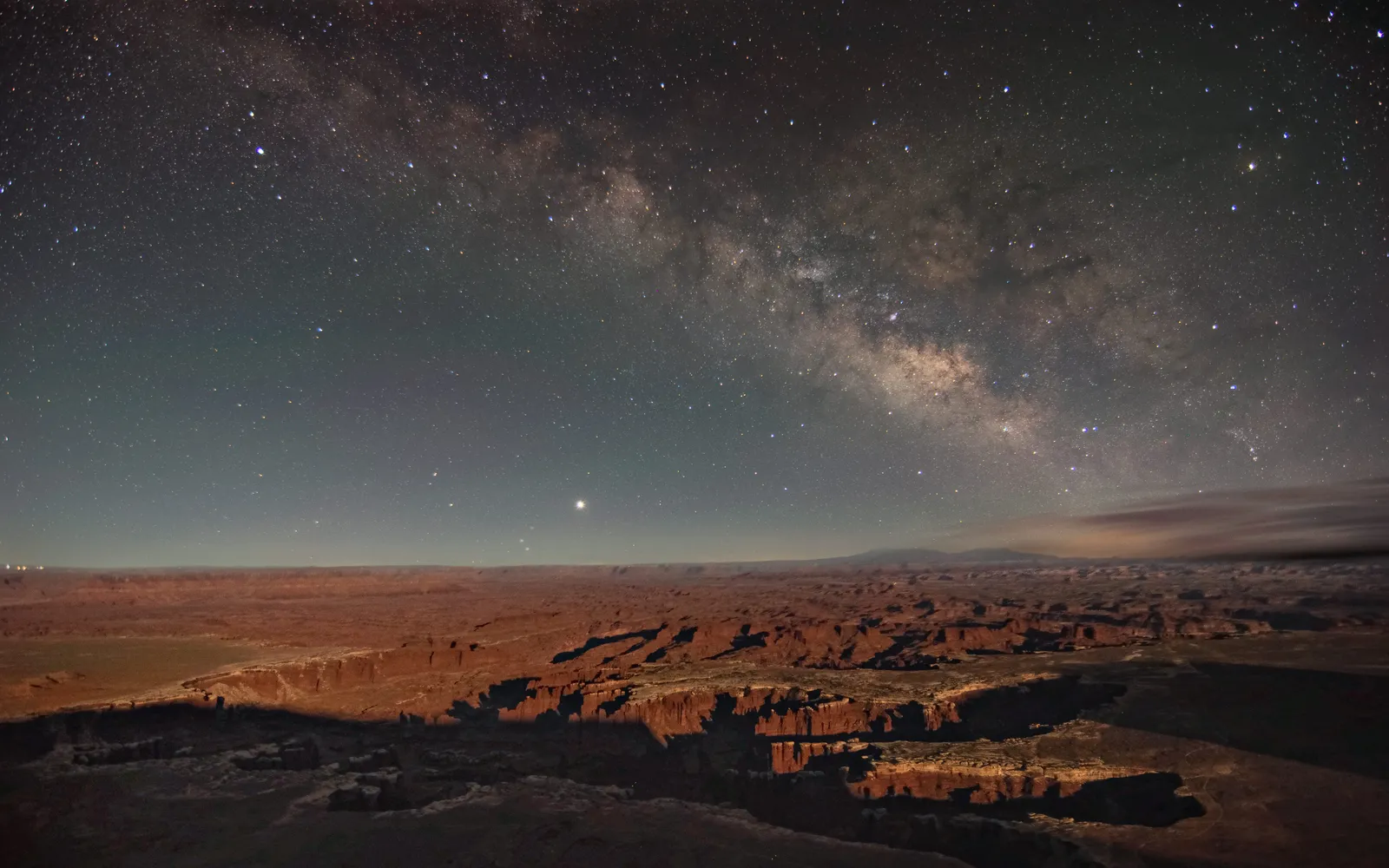
It's 2 am at Mesa Arch. The arch cuts a perfect window into the canyon below, framing the La Sal Mountains in the distance — and right now, in April or May, the Milky Way is rising through that opening at a diagonal angle that no photographer designed and no other location replicates. You've got maybe three hours before dawn washes it out, and you're not alone — there will be other astrophotographers here, even at this hour, because this shot is that good.
Canyonlands holds a Gold-Tier International Dark Sky Park certification, awarded in August 2015. The park is rated Bortle 1–2, depending on where you're standing. Accessible areas near Island in the Sky — where Mesa Arch is — sit closer to Bortle 2–3 because Moab's light dome sits 32 miles to the east/northeast. The deepest interior of the Maze may touch Bortle 1. Both ends of that range are exceptional by any practical standard.
📋 For trail info, seasonal strategy, and trip logistics, see the Canyonlands Complete Guide. This article is purely about the night sky.
Dark Sky Data
Canyonlands National Park holds a Gold-Tier certification from the International Dark Sky Association. The park's IDA application measured an average sky quality of 21.85 magnitudes per square arcsecond at zenith — in plain terms, the sky here is significantly darker than most people have ever experienced. At that level, the Milky Way structure is unmistakable to the naked eye, zodiacal light is visible in season, and the Andromeda Galaxy appears as an elongated smudge without optical aid.
The Bortle class discussion here deserves honesty. The NPS Night Skies team measured Bortle 2–3 in accessible park areas (Island in the Sky). Go-astronomy.com lists the park as Bortle 1, which reflects readings from the deepest Maze interior — technically accurate but not what you'll experience at Mesa Arch. Bortle 1–2 is the honest range: exceptional regardless of exactly where you land within it.
Bortle Class: 1–2 (accessible areas Bortle 2–3 per NPS; deepest interior approaches Bortle 1)
Sky Quality: Average 21.85 mag/arcsec² at zenith (DarkSky IDA application)
DarkSky Certification: Gold Tier — certified August 2015
Light Pollution: Moab dome ~32 miles east/northeast; south and west horizons completely clean
Darkest Accessible Sites: Grand View Point (looking south), Dead Horse Point State Park (adjacent, IDA certified)
Milky Way Visibility Calendar
At Canyonlands' latitude of roughly 38.3°N, the galactic core rises in the southeast, transits south at about 28–32° above the horizon, and sets in the southwest. That peak altitude is lower than what you get at Bryce Canyon (which sits 2,000 feet higher and gets the core 35–45° up) — but that lower angle is actually what creates the dramatic diagonal framing through Mesa Arch. The core rises right through the arch opening rather than passing over it. It's a composition the lower latitude enables, not despite it.
The Milky Way season opens in late February with pre-dawn windows and closes in October with brief post-dusk views. Peak shooting runs April through August, when the core is up long enough at dark-sky hours to make the drive worthwhile.
Month | Milky Way Visibility | Notes |
|---|---|---|
January | Not visible | Off-season |
February | Pre-dawn only | Season opens — cold, few photographers |
March | Pre-dawn, improving | Worth a trip for serious photographers |
April | ~1am–dawn | Prime window — comfortable temps, long core visibility |
May | ~11pm–dawn | Excellent — warm nights, good core altitude |
June | ~10pm–dawn | Peak season — long windows, summer heat during day |
July | ~9:30pm–dawn | Longest windows — flash flood risk, extreme heat |
August | ~9pm–midnight | Window shortening — still excellent |
September | Dusk window, ~2hrs | Brief post-dusk window, Andromeda strong |
October | Post-dusk, ending | Season closes — fall color as bonus |
November | Not visible | Off-season |
December | Not visible | Off-season |
2026 New Moon Dates (priority shooting nights):
May 17
June 15
July 14
August 13
September 11
Plan to arrive at your shooting location at least 1 hour before new moon dark to let your eyes adapt and secure your spot. At Mesa Arch, arriving 2+ hours early is not excessive on peak weekends.
Best Shooting Locations
1. Mesa Arch
Set up at Mesa Arch with your wide-angle pointed east/southeast, tripod legs pulled back from the rim, and your exposure dialed in before the core clears the canyon wall. In April and May, the Milky Way rises through the arch opening between roughly 1am and 3am — you're framing the galactic core, the La Sal Mountains visible through the arch below, and the canyon walls dropping away on either side. There is no other shot like it.
The walk from the parking area is 0.5 miles on a well-defined trail. Navigation in the dark is straightforward, but bring your headlamp (red mode only per NPS policy) and offline maps for the parking area approach. Other astrophotographers will almost certainly be there — communicate about positions and avoid sweeping white light across anyone's exposure.
Moab's light dome sits to the northeast and will show as a warm orange glow on the lower horizon behind the canyon. Most photographers treat this as a compositional element rather than a problem — it adds warmth to the sandstone and differentiates the foreground from the dark sky above.
CRITICAL SAFETY NOTE: Mesa Arch sits directly at the canyon rim. People have died here from getting too close to the edge. Set your tripod legs back from the rim and don't lean out over it to check your frame. In the dark, the edge is harder to judge than it looks in daylight. This is not a guideline — it's a life-safety issue.
2. Grand View Point
Grand View Point is accessible directly from the parking area at the southernmost tip of the Island in the Sky mesa — you can shoot from the overlook without hiking anywhere. The 2-mile round-trip trail extends further south along the rim if you want to find a solo position away from other photographers, but the main overlook alone gives you one of the cleanest dark horizons accessible from any US national park.
Looking south from here, there's no light pollution in any direction — no towns, no highway glow, nothing but canyon and sky all the way to the horizon. That clean sweep south and west makes Grand View Point the better choice for star trails, long panoramic sequences, and any shot where you want absolutely nothing on the horizon to contaminate the sky. The canyon walls below catch ambient starlight and glow softly in long exposures, giving you natural foreground texture without needing the arch framing. It's also consistently less crowded than Mesa Arch at night.
3. Dead Horse Point State Park (Adjacent)
Twenty minutes from the Island in the Sky visitor center, Dead Horse Point is separately certified as an IDA dark sky park and gives you a view that's different from anything inside Canyonlands: standing 2,000 feet directly above the Colorado River's horseshoe bend, shooting south and west into completely dark sky. The river reflects starlight on clear nights. The canyon depth creates a dramatic vertical drop that wide-angle compositions can use as a leading line into the sky.
It requires separate admission and its own trip, but it's worth treating as an alternative when Mesa Arch is overcrowded — and it often is. Dead Horse Point's ranger programs occasionally include stargazing events; check their schedule when you're planning your visit.
False Kiva — A Note
False Kiva was one of the most iconic astrophotography locations in Canyonlands — an ancient stone circle inside a sheltered alcove, framing the canyon and sky in a composition that combined archaeological history with the Milky Way overhead. You've seen this image. It was spectacular.
The alcove has been officially closed after repeated vandalism incidents prompted the NPS to restrict access. You can hike the unmarked trail and view the site from behind a rope barrier. The classic interior shot — standing inside the alcove to photograph the sky — is no longer legally accessible. Don't cross the barrier. The structure inside is roughly 1,000 years old, and what the vandals who caused this closure destroyed cannot be restored. It's off the shooting location list, full stop.
Nikon Z6II Settings
The 500 rule gives you your maximum shutter speed before stars start trailing. At 14mm on a full-frame Z6II, you've got about 35 seconds maximum — but use 20–25 seconds for genuinely sharp stars with minimal trailing. At 24mm, stay at or under 15 seconds.
Target | ISO | Aperture | Shutter | White Balance | Lens |
|---|---|---|---|---|---|
Milky Way wide field | 3200 | f/2.8 | 20–25s | 3800–4000K | NIKKOR Z 14-24mm f/2.8 S @ 14mm |
Star trails (interval) | 800–1600 | f/2.8 | 30s/frame | 3800K fixed | NIKKOR Z 14-24mm f/2.8 S |
Moon + landscape blend | 400–800 | f/2.8–f/4 | 1/125s–1s | 4500–5000K | NIKKOR Z 24-70mm f/2.8 S |
Long Exposure NR: OFF. It doubles your exposure time with a dark frame capture, wasting your shooting window. Deal with noise in post.
IBIS/VR: OFF on tripod. Vibration reduction can cause blur when it detects no motion to compensate for. Turn it off before you shoot.
Focus: Manual, 10× live view on a bright star. Autofocus doesn't work in the dark. Zoom into a bright star at 10× magnification on the live view, turn the focus ring until the star is as small and sharp as possible, then lock focus and leave it there.
Release: 2-second timer or remote shutter. Any physical contact with the camera during exposure shows up as blur. Set the 2-second delay and get your hands off the body before the shutter fires.
Red headlamp only, no light painting on rock. NPS policy prohibits light painting on natural surfaces. Red light also preserves your own night vision and won't ruin another photographer's 25-second exposure.
What to Photograph (Deep Sky Objects)
The Milky Way core through Mesa Arch is the signature shot and the reason most astrophotographers come here. From late March through August, the galactic core rises through the arch's opening between 1am and 3am. At 28–32° peak altitude, it clears the arch frame beautifully — the lower angle means the core runs diagonally through the opening rather than arcing high overhead, which gives the shot its distinctive composition. Shoot at 14mm to capture the full arch with canyon below and sky above.
Zodiacal light is visible at this sky darkness level and catches many photographers off-guard — it looks enough like light pollution that people sometimes mistake it for Moab's glow. It's actually sunlight reflected off interplanetary dust: a soft, pale triangular cone rising from the horizon. In spring, look for it in the east before astronomical dawn. In fall, look for it in the west after astronomical dusk. Shoot it at 14mm with 25-second exposures, slightly underexposed to preserve the cone's triangular structure against the surrounding sky.
The Andromeda Galaxy is worth targeting in September and October when it's high in the northeast sky. From Bortle 2 darkness, it's visible to the naked eye as an elongated smudge and resolves into a full elliptical shape in a tracked exposure. At 14mm it fits comfortably in a wide-field composition with foreground terrain; at 70mm+ you start pulling out the dust lane structure with a star tracker.
Ranger Programs & Astronomy Events
Canyonlands doesn't have a dedicated annual astronomy festival — unlike Bryce Canyon's Astronomy Festival, which draws thousands of visitors each June. What Canyonlands does offer is a rotating schedule of ranger-led stargazing programs between Island in the Sky, the Needles, and nearby Dead Horse Point State Park. Check the Island in the Sky visitor center schedule when you arrive — these programs are free, happen on new moon weekends, and put a ranger with a laser pointer next to you under genuinely dark sky. Dead Horse Point also runs its own ranger stargazing events, worth checking separately.
Gear for Astrophotography at This Park
Red headlamp — NPS policy prohibits white lights and light painting on natural surfaces at Canyonlands, and this is enforced. Red light protects your night vision and keeps you from ruining other photographers' long exposures. Clip it to your bag before you leave Moab — not buried inside it.
Tripod with adjustable legs — wind picks up at canyon rim positions, especially at Grand View Point, and a lightweight travel tripod will vibrate during 25-second exposures. Bring something with enough mass to stay stable, or carry a sandbag to hang from the center column. The uneven rim surface at Mesa Arch also demands fully independent leg adjustment — a ball head alone won't level you on sloped sandstone.
Extra batteries — cold temperatures drain lithium batteries faster than you expect. A 70°F April afternoon drops to 35°F by 2am, and a multi-hour session at Mesa Arch or Grand View Point can kill a Z6II battery in under 90 minutes. Bring at least two spares and keep them in an inside jacket pocket against your body to maintain warmth.
Remote shutter release — pressing the shutter button directly on a tripod transmits vibration that shows up as blur in a 25-second exposure. The Nikon MC-DC2 plugs straight into the Z6II with zero lag, no batteries, no pairing. Non-negotiable for pinpoint stars.
Gaia GPS — download offline maps before you leave Moab. The Mesa Arch trail is short and well-marked, but Grand View Point and any Needles-adjacent shooting requires reliable offline navigation with no cell signal. The free version handles this.
Anti-fog lens wipes — night dew forms on lenses in the cold desert air after midnight. Pre-treat your front element when you arrive at the location, and carry a lens cloth for clearing moisture between exposures. Saves shoots when the temperature drops sharply after 1am.
Warm layers — more than you think. Canyonlands runs warm during the day and cold at night year-round. Standing motionless at a rim for three hours makes the cold hit faster than hiking through it. Pack a full insulated layer system even in shoulder season — not a gear purchase, just a packing reminder.
Frequently Asked Questions
What is Canyonlands' Bortle class?
Bortle 1–2, depending on where you're shooting. Accessible areas like Island in the Sky are Bortle 2–3 due to Moab's light dome; the deepest interior of the Maze approaches Bortle 1. Either end of the range is exceptional — at Bortle 2, the Milky Way structure is unmistakable to the naked eye.
What's the best month for Canyonlands astrophotography?
April and May hit the best balance of conditions: comfortable overnight temperatures, Milky Way windows from around 1am through dawn, and relatively low crowds. June through August has the longest windows but daytime temperatures exceed 100°F — viable if you can sleep through the heat and shoot at night. The April 17 new moon in 2026 is a particularly good target date.
How do I photograph Mesa Arch with the Milky Way?
Arrive at 1–2am in April or May and set up facing east/southeast through the arch. Use your widest angle lens (14mm on the Z6II) at ISO 3200–6400, f/4, and 20–25 seconds. White balance at 3800–4000K. Focus manually on a bright star at 10× live view magnification. Pull your tripod legs back from the canyon rim — the edge drops away directly behind the arch. The Milky Way rises through the arch opening and the warm glow from Moab on the lower horizon often adds to the composition.
What are the Z6II starting settings for Canyonlands?
For the Milky Way at 14mm: ISO 3200, f/2.8, 20–25 seconds, white balance 3800K. Turn IBIS and Long Exposure NR both off. Focus manually using 10× live view on a bright star. Shoot with a 2-second timer or a remote shutter release to avoid camera shake. Check your histogram after the first frame — if you're clipping highlights from the Moab glow on the eastern horizon, reduce ISO rather than shortening the shutter.
Can I still photograph False Kiva?
No — not legally from the interior. The alcove has been officially closed following vandalism of the archaeological site. You can hike the unmarked trail and view it from behind a rope barrier. The classic interior shot with the Milky Way overhead is no longer accessible. Don't cross the barrier.
Keep reading
More on this topic from TrailVerse