Grand Teton Astrophotography 2026: Bortle 2 Skies, Milky Way & Z6II Settings
Bortle 2 skies, Milky Way seasons, and Grand Teton’s best night locations—with practical Z6II settings for 2026 astro trips.
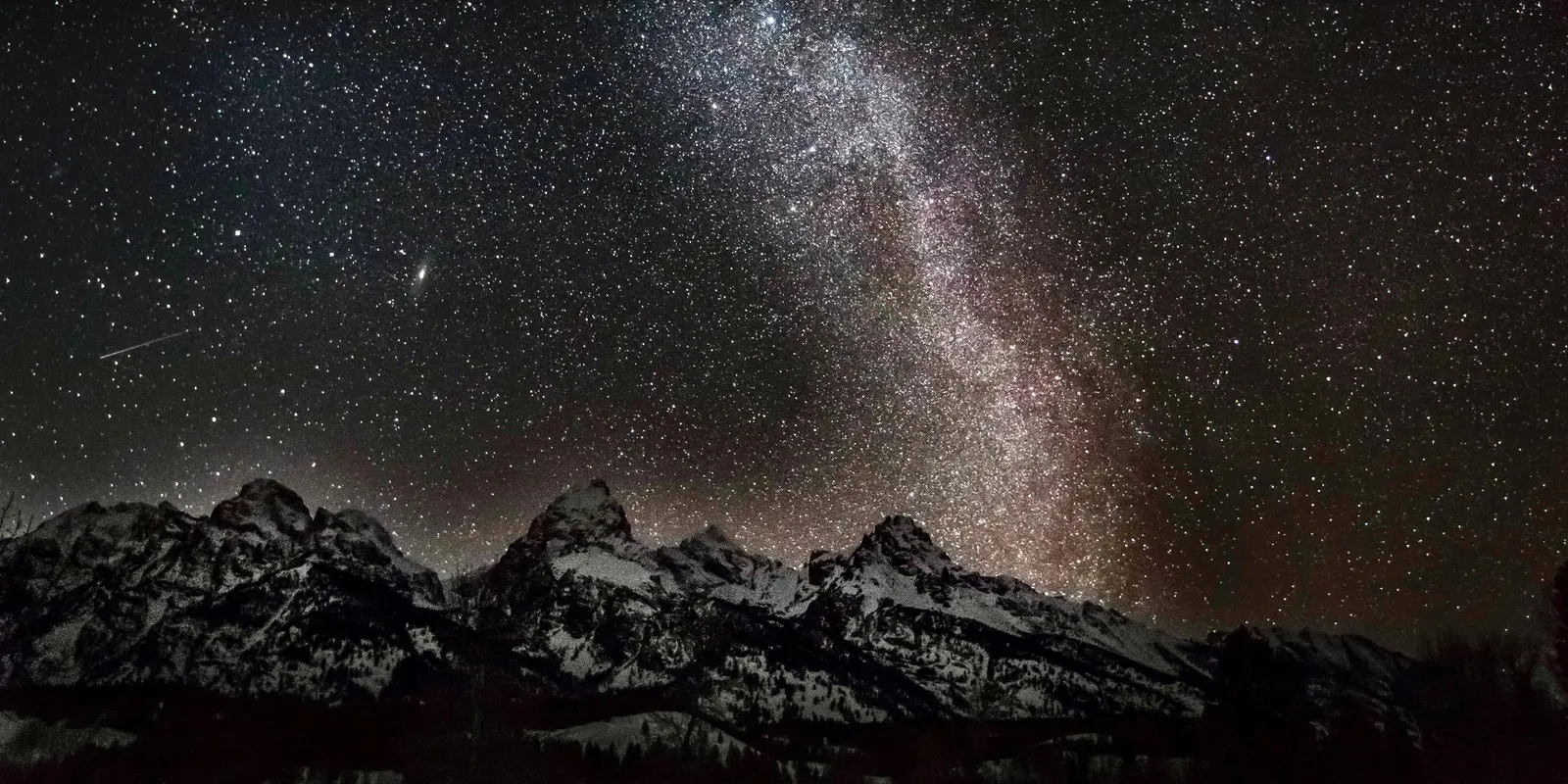
Table of Contents
Stand at Antelope Flats on a moonless July night and the Milky Way doesn't look like a smear of light — it looks like a structure. You can see individual dark lanes cutting through it, bright nebulae glowing pink-orange without a camera, and a band of light bright enough that you can read a map by it. That's what Bortle Class 2 actually means. Grand Teton doesn't have an IDA dark sky certification (neither does Yellowstone — neither has pursued it), but the skies here are among the darkest accessible by paved road in the Rocky Mountain region. Teton County itself is the world's first International Dark Sky Community.
📋 For trail info, seasonal strategy, and trip logistics, see the Grand Teton Complete Guide. This article is purely about the night sky.
Dark Sky Data
Grand Teton National Park holds a Bortle Class 2 rating in its northern sections — the Antelope Flats area and locations north of Moran Junction. Southern sections closer to Jackson rate approximately Bortle Class 3. The park has not pursued IDA certification, but its sky quality matches or exceeds many certified parks.
Bortle Class: 2 (northern park), 3 (southern sections near Jackson)
Sky Quality: Approximately 21.5–21.9 mag/arcsec² at the darkest sites
DarkSky Certification: Not certified — Teton County itself is IDA's first Dark Sky Community
Darkest Site: Antelope Flats / Mormon Row area, northern park boundary
Light Pollution: Jackson, WY (~12 miles SSE) creates a low dome (5–8° altitude) on the SSE horizon. Face northwest toward the Tetons or due north for cleanest skies.
At Bortle 2, the night sky has visible three-dimensional texture. The Milky Way's dark dust lanes are distinct. You can see the Andromeda Galaxy with your naked eye as a small oval smudge. The zodiacal light (a faint pyramid of light from interplanetary dust) is visible in spring and fall. On the clearest July nights, the galactic core is bright enough to cast faint shadows on light-colored surfaces.
Milky Way Visibility Calendar
The galactic core rises in the southeast, arcs through due south at its peak altitude of approximately 23–24° above the horizon (at Grand Teton's latitude of 43.7°N), then sets in the southwest. That relatively low peak altitude is the key constraint — you need a clear, unobstructed southern horizon, which all three of the top shooting locations below provide. The low peak also means the core appears more horizontal and elongated in compositions, which pairs beautifully with the wide, flat Jackson Hole valley and the barn foregrounds at Mormon Row.
Month | Core Visible | Hours/Night | Best Window | Notes |
|---|---|---|---|---|
January | No | 0 | — | Core below horizon |
February | No | 0 | — | Core below horizon |
March | Pre-dawn only | ~1 | 4–5am | Season opening — very low core |
April | Pre-dawn | ~2 | 3–5am | Cold, improving geometry |
May | Late night | 3–4 | 1–4am | Season starts; core still rises late |
June | Most of night | 5–6 | 11pm–4am | New moon June 15 — excellent window |
July | Most of night (peak) | 5–6 | 10pm–4am | Best month — core highest, longest dark |
August | Evening–midnight | 5–6 | 9pm–2am | New moon Aug 12 (solar eclipse) — still excellent |
September | Early evening | 3–4 | 8:30–11:30pm | Core sets early; fall colors as foreground |
October | Dusk only | ~1.5 | 8–9:30pm | Season closing fast |
November | No | 0 | — | Core below horizon |
December | No | 0 | — | Core below horizon |
2026 New Moon Dates for Peak Months
June 15, 2026 — Prime shooting window: June 12–19
July 14, 2026 — Prime window: July 11–18. This is your target date for Grand Teton. Maximum dark hours, highest core altitude, warmest nights.
August 12, 2026 — Solar eclipse new moon. Prime window: August 9–16. The eclipse happens during the day; the dark window around it is fully usable for night photography.
Bottom line: Book July 11–17 if you're making this trip specifically for the Milky Way. June 12–19 is the second-best option if July doesn't work.
Best Shooting Locations
Jackson sits 12 miles south-southeast of the park. From all three locations below, face northwest toward the Teton Range or due north for cleanest skies — the Jackson dome stays out of frame. Signal Mountain's elevation puts the dome below your eye level entirely.
1. Mormon Row / T.A. Moulton Barn (Antelope Flats)
The Moulton Barn is probably the most photographed Milky Way foreground in the Rocky Mountain region. The red barn faces west toward the Teton Range, and in July the galactic core arcs from the SE overhead — giving you a window in midsummer where the core rises behind the barn and appears to stretch toward the mountains. The open sage flats of Antelope Flats mean you have a wide, unobstructed sky in every direction.
Getting there at night: Park on the dirt Mormon Row road, which has no barrier and is accessible 24 hours. The main T.A. Moulton Barn is a short walk (<5 minutes) from the parking area. Bring a red headlamp — white light ruins other photographers' shots, and NPS prohibits light painting on historic structures. The barn itself is a protected historic structure; don't lean equipment against it or climb on it.
Best season: June through August. The July 14 new moon window (July 11–18) is when the core is highest and most dramatic over the barn.
2. Snake River Overlook
Ansel Adams shot this view in daylight in 1942. At night, the S-curve of the Snake River catches ambient starlight and moonlight, and the Teton Range fills the western sky. The Milky Way in late July arcs from the SE and crosses roughly perpendicular to the river bend — the composition gives you foreground (river), midground (valley), background (Tetons), and sky all in one frame. Ambitious but achievable with a wide lens.
Getting there at night: The overlook is a signed pull-off on US-89/191, no hiking required. Gravel parking for 15–20 cars. It gets competitive during peak July weekends — arrive by 10pm to claim a spot. A sturdy tripod with a ball head is essential here because the overlook surface is uneven gravel.
Best season: Mid-July to mid-August is optimal — the core position aligns well with the river bend when it transits due south. June works but the core is lower on the horizon.
3. Signal Mountain Summit
At 7,593 feet — about 1,000 feet above the valley floor — Signal Mountain gives you an elevated vantage point that transforms the night sky experience. You're above most of the valley's atmospheric haze, and the elevation accentuates a rare phenomenon: airglow, a subtle green-to-red luminescence caused by oxygen atoms in the upper atmosphere. On clear nights it appears as faint undulating curtains near the horizon — it looks like a weak aurora but is entirely natural and happens every clear night, visible here because of the darkness and altitude.
Getting there at night: A paved 5-mile road leaves Teton Park Road and climbs to the summit — driveable all the way to the top. The summit has a small parking area. It can be windy; bring a warm layer even in July (temperatures drop 15–20°F compared to the valley). Summit road is typically open May through October.
Best season: June through September. The 360° panorama means you're not locked into one composition — shoot north (pure darkness), west (Tetons), or south (valley + distant Jackson glow as an element in long exposures, which from this elevation reads as warm ground glow rather than sky-filling dome).
Nikon Z6II Settings
The Z6II is an excellent Milky Way camera. Its back-illuminated full-frame sensor handles high ISO cleanly, the NIKKOR Z 14-24mm f/2.8 S is sharp to the corners even wide open, and the electronic shutter gives you vibration-free exposures. At Bortle 2, you don't need to push the sensor hard — the sky itself gives you plenty of signal.
500-Rule shutter calculations:
500 ÷ 14mm = 35 seconds maximum before star trailing
500 ÷ 20mm = 25 seconds
500 ÷ 24mm = 20 seconds
500 ÷ 35mm = 14 seconds
Scenario | ISO | Aperture | Shutter | White Balance | Lens |
|---|---|---|---|---|---|
Milky Way Wide Field | 3200 | f/2.8 | 20–25s | 3800K | NIKKOR Z 14-24mm f/2.8 S @ 14mm |
Star Trails (interval stack) | 800–1600 | f/2.8 | 60s/frame | 3800K fixed | NIKKOR Z 14-24mm f/2.8 S |
Moon + Landscape | 400–800 | f/5.6–f/8 | 0.5–2s | 5500K | NIKKOR Z 24-70mm f/2.8 S |
Z6II-Specific Tips
Long Exposure NR: OFF. When it's on, the camera takes a "dark frame" after each shot that takes as long as the exposure itself — you lose half your shooting time and can't shoot consecutive frames. Shoot raw and deal with noise in Lightroom instead.
IBIS/VR: OFF on tripod. When you're on a solid tripod, in-body stabilization can introduce micro-vibration that slightly softens stars on 30-second exposures. Flip it off in the shooting menu.
Focus manually on a star. Switch the lens to manual focus, then use the Z6II's magnified live view (tap the + button for 10× zoom) on the brightest star you can find. Turn the focus ring slowly until the star collapses from a soft blob to a tight point. Lock it there and don't touch the lens for the rest of the night.
2-second self-timer or remote release. Pressing the shutter button introduces a tiny vibration. Use 2-second self-timer or an MC-DC2 remote for completely vibration-free triggering. At 30 seconds, even small vibrations show.
Foreground blending. The Z6II nails the sky at ISO 3200 / f/4 / 30s at Bortle 2. Your foreground (the barn, mountain silhouette) will be underexposed at that setting. Shoot one dedicated foreground frame at ISO 800 / f/4 / 60–120s during blue hour, then blend in post. It takes one minute of planning and dramatically improves the final image.
NPS light painting policy. Light painting on the Moulton Barns or any historic structure is prohibited by NPS regulation. Use a red headlamp only near structures. If you want warm barn illumination, it needs to be from ambient sources (distant city glow, moon).
What to Photograph: Deep Sky Objects
At Bortle 2 in July, three objects deserve attention beyond the Milky Way itself.
The galactic center region in Sagittarius. Due south in July, roughly 20° above the horizon. This is the busiest, brightest, most chaotic part of the Milky Way — the direction of the galactic core itself. The "steam" rising from the Sagittarius Teapot asterism in binoculars looks like a glowing fog. In a camera frame at ISO 3200, the pink nebulae embedded in this region are bright enough to show color without any stacking.
The Andromeda Galaxy. Rises in the northeast in August and September — a small, elongated oval smudge easily visible with the naked eye at this darkness level. In binoculars it fills most of the field of view with a soft gradient from bright core to fading outer disk. In a 30-second exposure with the Z6II at ISO 1600, the dust lane along one edge starts to resolve.
The Perseus Double Cluster. Two neighboring star clusters in Perseus, best in binoculars from late summer. They appear as two hazy patches of tightly packed stars side by side — more satisfying to look at than you expect, especially on a dark night when you can see the surrounding stellar field clearly.
Ranger Programs & Astronomy Events
Wyoming Stargazing is the most active astronomy program connected to Grand Teton — a 501(c)(3) nonprofit that runs both free public programs and private guided tours. Free programs run at the Village Road Transit Center and R-Park during the summer. Private stargazing tours start at $175/person for multi-group programs (May–October) and include drives to dark sky locations inside the park itself; their astrophotography package adds professional photography instruction for $165 extra. They were instrumental in getting Teton County designated as the world's first International Dark Sky Community.
The NPS itself runs informal star parties at Colter Bay on select summer evenings — check the park's event calendar for 2026 programs after May 1, when the summer schedule is usually posted.
Gear for Astrophotography at Grand Teton
Summer nights in Jackson Hole are cold. July lows can hit 35–42°F at the valley floor; Signal Mountain summit will be colder. Plan for base-layer-to-puffer-jacket range for any night shoot.
Petzl Tikka CORE — required at every shooting location. White light ruins your dark adaptation and other photographers' exposures, and NPS prohibits light painting on historic structures like the Moulton Barns. The Tikka CORE's 450-lumen output is plenty for navigating the Mormon Row dirt road or the Signal Mountain summit parking area in the dark, and the dedicated red mode is a single button press away. Rechargeable via USB so you're not buying batteries before every trip.
Sturdy tripod — wind on Signal Mountain summit will shake a lightweight tripod during 30-second exposures. The Snake River Overlook surface is uneven gravel that demands fully adjustable legs. Minimum 3.5kg payload capacity, and bring a sandbag or hang your bag from the center column for extra stability in wind.
Extra batteries — cold drains lithium batteries faster than you expect. A full Z6II battery can die in 90 minutes during a Signal Mountain shoot in May or September when valley temps are already in the 30s at night. Bring at least two spares and keep them in an inside jacket pocket against your body.
Remote shutter release — pressing the shutter button transmits vibration that shows up as star blur in 30-second exposures. The Nikon MC-DC2 plugs straight into the Z6II with zero lag, no batteries, no pairing.
Sky-Watcher Star Adventurer GTi — a tracker is worth packing at Bortle 2. At this darkness level you can push exposures to 2–3 minutes tracked, which brings out faint nebulae in the galactic center that single 30s frames miss. Optional but transformative if you want to do serious deep-sky work.
PhotoPills — iOS/Android app for planning the exact Milky Way arc position over the Moulton Barn using AR mode. Essential for pre-visualizing composition before you drive to the location. Pair with the free Stellarium app for object identification and shooting window calculations around moonrise/moonset.
Frequently Asked Questions
What is Grand Teton's Bortle class?
Bortle 2 in northern sections (Antelope Flats, Mormon Row), Bortle 3 closer to Jackson. The park isn't IDA-certified but Teton County itself is IDA's first Dark Sky Community.
What is the best month for Milky Way photography at Grand Teton?
July. The galactic core is at its highest altitude, dark hours are long, nights are warm enough for comfortable shooting, and all park access roads are fully open. The new moon falls on July 14, 2026 — plan your trip for July 11–17 for the best conditions.
What Nikon Z6II settings should I use for the Milky Way at Grand Teton?
Start at ISO 3200, f/2.8, 30 seconds, and 3800K white balance with the NIKKOR Z 14-24mm f/2.8 S at 14mm. Long Exposure NR and IBIS should both be off. Focus manually using 10× live view on a bright star. At Bortle 2 you may find ISO 3200 is all you need, unlike parks where you'd push to 6400.
What is the best shooting location for Milky Way photography in Grand Teton?
Mormon Row (the T.A. Moulton Barn area) is the most popular for a reason — the historic barn makes an iconic foreground and the Teton Range provides a dramatic western backdrop. Signal Mountain Summit is the best option for a full-sky, wide-open composition without a specific foreground element. Snake River Overlook is the most technically ambitious but produces the most dramatic images when the composition comes together.
Does the moon affect Milky Way shooting at Grand Teton?
Yes. Even a half moon is bright enough to wash out the fainter parts of the Milky Way at Bortle 2. Shoot within 3–4 days of new moon for peak results — that means June 12–19, July 11–18, or August 9–16 for 2026. Avoid nights when the moon rises before midnight during peak summer.
Keep reading
More on this topic from TrailVerse