Yellowstone 2026: Timed Entry, Crowds & Planning Guide
No timed entry in 2026—bridge delays, peak crowds, fees, and the trails and seasons that actually matter for Yellowstone trips.
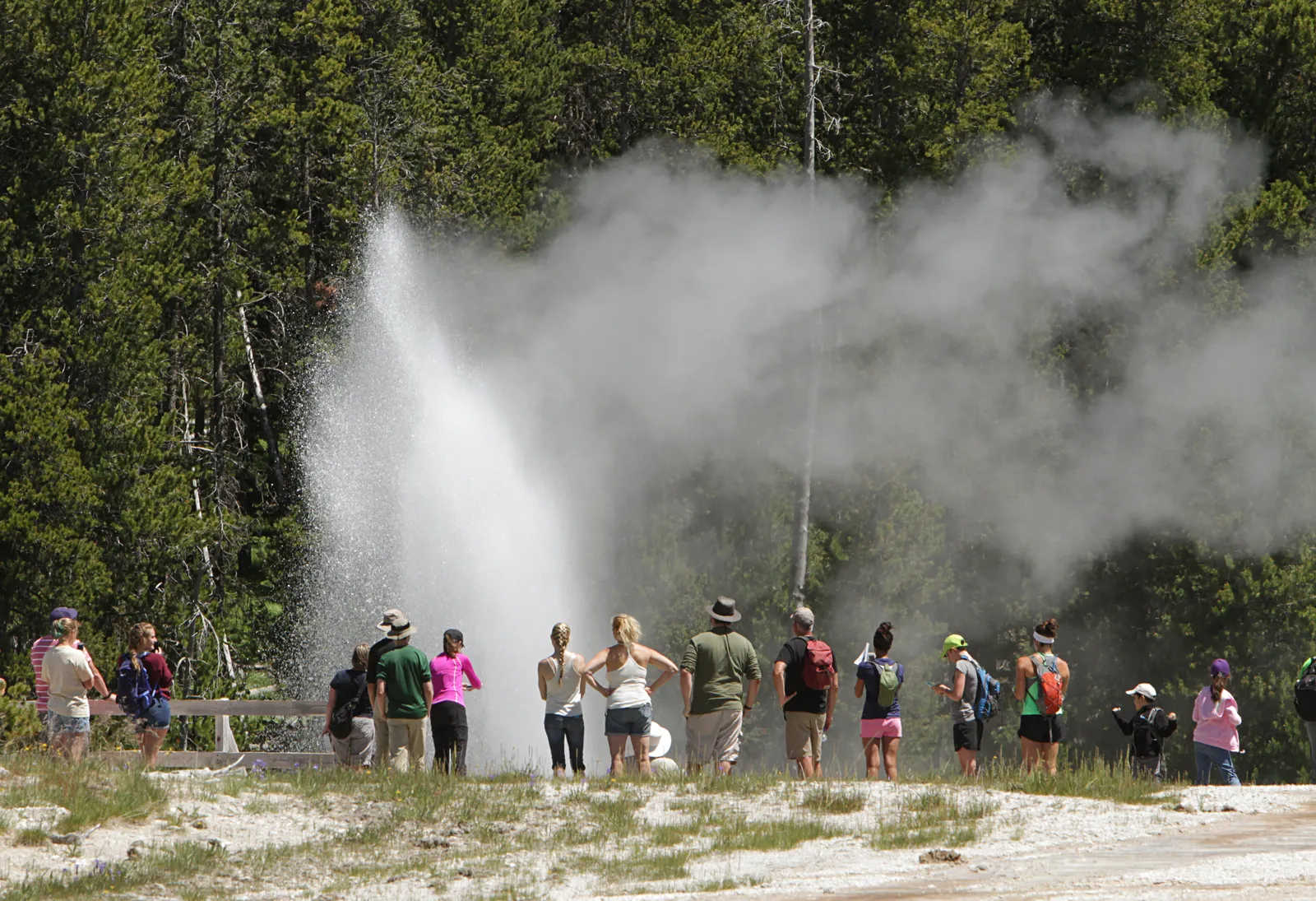
Table of Contents
Yellowstone National Park in 2026 requires no timed-entry reservation — unlike Arches or Glacier, you can drive in with a valid pass whenever you want. That's the good news. The complicating factor this year is multiple bridge construction projects causing delays at both the North Entrance (Gardiner) and along the Northeast Entrance Road (Yellowstone River Bridge near Tower Junction). Build wait times into your timeline. If you're coming from Jackson Hole via the South Entrance, that road opens May 8 — earlier than most people expect.
2026 Access Updates
No timed entry required this year. The park runs a standard vehicle pass system — no advance vehicle reservation needed for any entrance in 2026. That said, July daily visitor counts routinely hit 30,000+, and parking at major thermal areas fills completely by 9am. The absence of a permit system doesn't mean the absence of crowds; it just means the crowds are self-organizing chaos rather than managed chaos.
A new $100/person surcharge for non-US residents applies starting January 2026 at Yellowstone and 10 other high-visitation parks. This is separate from the entrance fee — it applies per person on top of standard admission. Non-residents can buy the $250 America the Beautiful Non-Resident Annual Pass which waives the surcharge plus covers three additional adults in the party.
Construction delays to know:
Gardiner River High Bridge (North Entrance from Gardiner, MT): up to 15-minute delays through late October 2026
Yellowstone River Bridge near Tower Junction (Northeast Entrance Road): up to 30-minute delays, project completes fall 2026
North Entrance Road realignment ("Old Gardiner Road"): up to 30-minute delays from ongoing improvements
Road opening dates:
April 17: West Entrance, North Entrance, Northeast Entrance — opens with limited interior road access
May 1: East Entrance (Sylvan Pass)
May 8: South Entrance (from Grand Teton/Jackson)
May 22: Dunraven Pass — Mount Washburn becomes accessible
📋 Park hours, entrance fees, live alerts, campground bookings, and trail maps are all on the TrailVerse park page — this guide covers the strategy.
Why This Park Is Worth It
Yellowstone sits on top of a supervolcano with a magma chamber the size of Chicago, roughly 4–5 miles underground. That's not background trivia — it's the reason the ground steams, the reason pools of 188°F water bubble next to walking paths, the reason more than 500 of the world's active geysers exist within one park boundary. More than half the world's geysers are here.
The wildlife puts Yellowstone in a category of its own. Wolves were reintroduced to Lamar Valley in 1995 after a 70-year absence, and their return triggered one of the most documented ecological cascades on record — wolf presence changed elk grazing behavior, which allowed riverbank vegetation to recover, which literally changed the course of rivers. You can see the evidence in Lamar Valley today. Grand Prismatic Spring adds another layer: its rings of orange, yellow, and green come from heat-adapted bacteria thriving at different temperatures — pure biology, no filter.
When to Go (And Why It Matters)
September is the best month for most visitors — elk rut in full display, grizzlies gorging on whitebark pine nuts before hibernation, and roughly 40% fewer visitors than July. The boardwalks clear out. The light gets golden earlier. It's the version of Yellowstone that makes sense.
June is the sweet spot if you're combining with Grand Teton — all roads open by mid-June, wolf packs are moving pups to rendezvous sites in Lamar, and crowds haven't fully peaked. July has everything accessible but requires committing to early starts (before 9am) or late evenings for any popular thermal area.
Season | Dates | Temps (Day/Night) | Crowd | Best For | Watch Out For |
|---|---|---|---|---|---|
Spring | May–early Jun | 50–65°F / 25–40°F | Low | Bears/wolves with cubs, minimal crowds | South Entrance closed until May 8; Dunraven Pass until May 22 |
Summer | Jun–Aug | 70–80°F / 40–55°F | Very High | Full access, bison rut Jul–Aug, thermal photography | 30,000+ daily visitors July; afternoon lightning daily |
Fall | Sep–Oct | 55–70°F / 25–40°F | Moderate | Elk rut, grizzlies foraging, empty boardwalks | Lodges close progressively October–November |
Winter | Nov–Apr | 10–30°F / below 0°F | Very Low | Snowcoach tours, wolf tracking in snow | Most roads closed; limited infrastructure |
The Trails Worth Knowing About
Grand Prismatic Overlook Trail is the access point most visitors miss. The boardwalk at Midway Geyser Basin gives you a ground-level view of the spring — impressive, but you can't see the famous color rings. The overlook trail (1.5 miles round trip, minimal elevation) gives you the aerial view that appears in every photograph of Yellowstone. Go at sunrise or after 5pm — midday parking is brutal and the light is flat.
Old Faithful timing tip: Old Faithful erupts roughly every 90 minutes, and the next predicted eruption is posted at the Old Faithful Visitor Education Center and on the free NPS Yellowstone app. Check before you arrive — there's no point standing in the crowd for 80 minutes when you could hit Geyser Hill, Morning Glory Pool, or Biscuit Basin in the meantime and walk back for the show.
Mount Washburn is the park's best day hike, and it's only accessible after Dunraven Pass opens on May 22. Six miles round trip from the Dunraven Pass trailhead with 1,400 feet of gain — manageable for most hikers. The summit fire lookout has a 360° view that on clear days extends 100 miles south to the Teton Range. Bighorn sheep are reliably spotted near the summit in summer. Don't rush it.
Hellroaring Creek Canyon is Yellowstone's best-kept secret. Most people stop at the suspension bridge over the Yellowstone River and turn around. If you follow the boot path downstream from the bridge for 1–2 miles, you reach the confluence of Hellroaring Creek with the river — a dramatic canyon overlook with no sign pointing to it and almost no other people. Budget an extra hour beyond the standard turnaround point.
Fairy Falls consistently underdelivers on first glance until you realize what's behind it. The trail passes through a geothermal flat that feels nothing like the boardwalk experience — steam vents, prismatic pools visible through the trees, and a stretch of trail at night that qualifies as some of the darkest sky access in the park. The falls themselves are 200 feet tall and see a fraction of the Old Faithful crowds for the same 5-mile round-trip investment.
What Most People Get Wrong
Most people underestimate the distances. The figure-eight Grand Loop Road is 142 miles with a 45 mph speed limit — a complete circuit with stops takes 6–8 hours minimum, and most visitors budget half that. Lamar Valley is 90 minutes from Old Faithful, which is why most visitors skip it. Don't skip it. The northeast corner of the park is where the wolves, the open sky, and the actual Serengeti experience are. If you only have two days, split them: one day for the thermal features (Old Faithful, Grand Prismatic, Norris Geyser Basin), one day entirely in Lamar Valley starting at dawn.
Hayden Valley deserves equal billing with Lamar. Sitting between Yellowstone Lake and the Grand Canyon of the Yellowstone, Hayden is where you're most likely to see bison herds at scale, plus regular grizzly and wolf sightings. It's also closer to the thermal loop than Lamar — combine it with a thermal day rather than choosing between Hayden and the geysers.
The thermal features kill more people than the wildlife. Yellowstone has more deaths from hot springs than from bears. The ground around thermal features is fragile crust over 200°F+ water — boardwalks exist for a reason. Don't step off them, don't reach into pools, and keep kids within arm's reach.
Wildlife distance rules are enforced, not suggested. NPS rules: 100 yards from bears and wolves, 25 yards from bison, elk, and all other wildlife. Bison cause more visitor injuries than any other animal in the park — they look slow and photogenic, then sprint at 35 mph when you cross their comfort zone. Use a telephoto or your binoculars instead of stepping closer.
Download offline maps before you enter. Cell service drops across most of the park without warning. Gaia GPS and the NPS Yellowstone app both support offline mode — download your areas before the West Entrance, not after you're already inside.
The Night Sky
Yellowstone's remote interior reaches Bortle Class 1 — the darkest rating on the scale. The park is actively pursuing International Dark Sky Park certification. On a July new moon night, the Milky Way is bright enough to cast shadows on the ground and the galactic core spans the entire southern sky.
🌌 The Yellowstone Astrophotography Guide — Bortle class by location, Nikon Z6II settings, Milky Way calendar, and best shooting spots including Grand Prismatic Steam at night — publishes May 7th. Subscribe to get it in your inbox.
Getting There & Base Camp
West Yellowstone, MT, is the most practical gateway — direct access to the West Entrance, full services, and the best selection of lodging outside the park. Drive time is roughly 5 hours from Salt Lake City, 3 hours from Billings, and 1.5 hours from Idaho Falls.
If you're combining Yellowstone with Grand Teton — and you should — Jackson, WY makes an ideal base for the first leg of the trip. The South Entrance opens May 8 and gives you a natural progression north from Grand Teton. See the Grand Teton Complete Guide for the strategy on that pairing.
Critical logistics: Gas is available at Canyon Village, Grant Village, and Tower-Roosevelt inside the park, but prices run significantly higher than outside. Fill up in gateway towns. Lodging inside the park (via Xanterra) books out 12 months in advance — if you didn't book by January, plan to stay outside and drive in.
Gear for This Park
Bear spray — Yellowstone has one of the highest densities of grizzly bears in the lower 48. Carry it worn on your hip, not in your pack — you need to access it in under 3 seconds. Bear encounters in the LeHardys Rapids area, Mary Mountain Trail, and through Hayden Valley are common; treat every trail above the boardwalk as bear country. TSA prohibits flying with bear spray — buy locally in West Yellowstone or Jackson.
Gaia GPS — no substitute for offline maps in a park with near-zero cell coverage across most of its 2.2 million acres. Download the park layers before you enter, not after. The free version handles this; Premium adds weather overlays that matter for summer afternoon lightning.
Lightweight insulated jacket — Lamar Valley temperatures drop below 40°F on July nights and afternoon thunderstorms move through the interior daily. Even summer visitors need a real insulating layer, not a fleece pullover. A packable down or synthetic puffy stows in your daypack and saves the day when an unexpected storm rolls in at Mount Washburn or Hayden Valley.
Zeiss Terra ED 8x42 binoculars — the distances in Lamar Valley mean you'll see wolf specks a mile away without them. A quality 8×42 binocular is the single item that turns Lamar Valley wildlife watching from frustrating to extraordinary. Wolf spotters congregate at known pullouts and often share scopes, but bring your own glass — the magic moment isn't always at the shared scope.
Wide-brim sun hat — the park sits at an average elevation of 8,000 feet, and UV exposure at altitude is significantly higher than at sea level. The open meadows of Hayden and Lamar Valley have no shade cover for miles. Sunburn at 8,000 feet happens fast.
Frequently Asked Questions
Is there timed entry at Yellowstone in 2026?
No — Yellowstone does not use a vehicle reservation or timed entry system in 2026. You drive in with a valid pass at any time. The trade-off is unmanaged crowding at peak times, so plan popular stops before 9am or after 5pm in July.
How does Yellowstone compare to Grand Teton — which should I do first?
If you're flying into Jackson, start with Grand Teton (day 1–2), then drive north to Yellowstone via the South Entrance on day 3. Grand Teton is the dramatic mountain scenery; Yellowstone is the geothermal ecosystem and wildlife diversity. They complement each other completely and are worth doing together.
How many days do you need at Yellowstone?
Two days gets you the highlights — one day for the thermal loop (Old Faithful, Grand Prismatic, Norris), one day for Lamar Valley wildlife. Four days lets you add Mount Washburn, the Grand Canyon of the Yellowstone at Artist Point, Hayden Valley, and time to actually sit and wait for wildlife rather than drive past it. Most visitors who say they "saw everything in a day" missed Lamar Valley entirely.
What's the best entrance to use in 2026?
Coming from Jackson/Grand Teton: South Entrance (opens May 8). Coming from Bozeman/Billings: North or Northeast Entrance — note the 15-minute Gardiner River High Bridge delays and 30-minute Yellowstone River Bridge delays this year. Coming from Idaho: West Entrance (West Yellowstone, MT). The West Entrance is the busiest by volume; Northeast Entrance is the least crowded and deposits you directly into Lamar Valley.
🗺️ Planning your trip? TrailVerse's AI trip planner builds custom itineraries based on your dates, interests, and pace.
➡️ Doing both parks? Use the Compare National Parks tool with Yellowstone and Grand Teton selected to weigh fees, parking, and amenities side by side, then send your choice into the AI Trip Planner to build a 5–7 day Wyoming itinerary.
Keep reading
More on this topic from TrailVerse