Arches Astrophotography 2026: Bortle 2 Skies, Milky Way & Z6II Settings
Milky Way shots through North Window and other Arches icons—dark-sky timing, Moab logistics, and night photography settings that work.
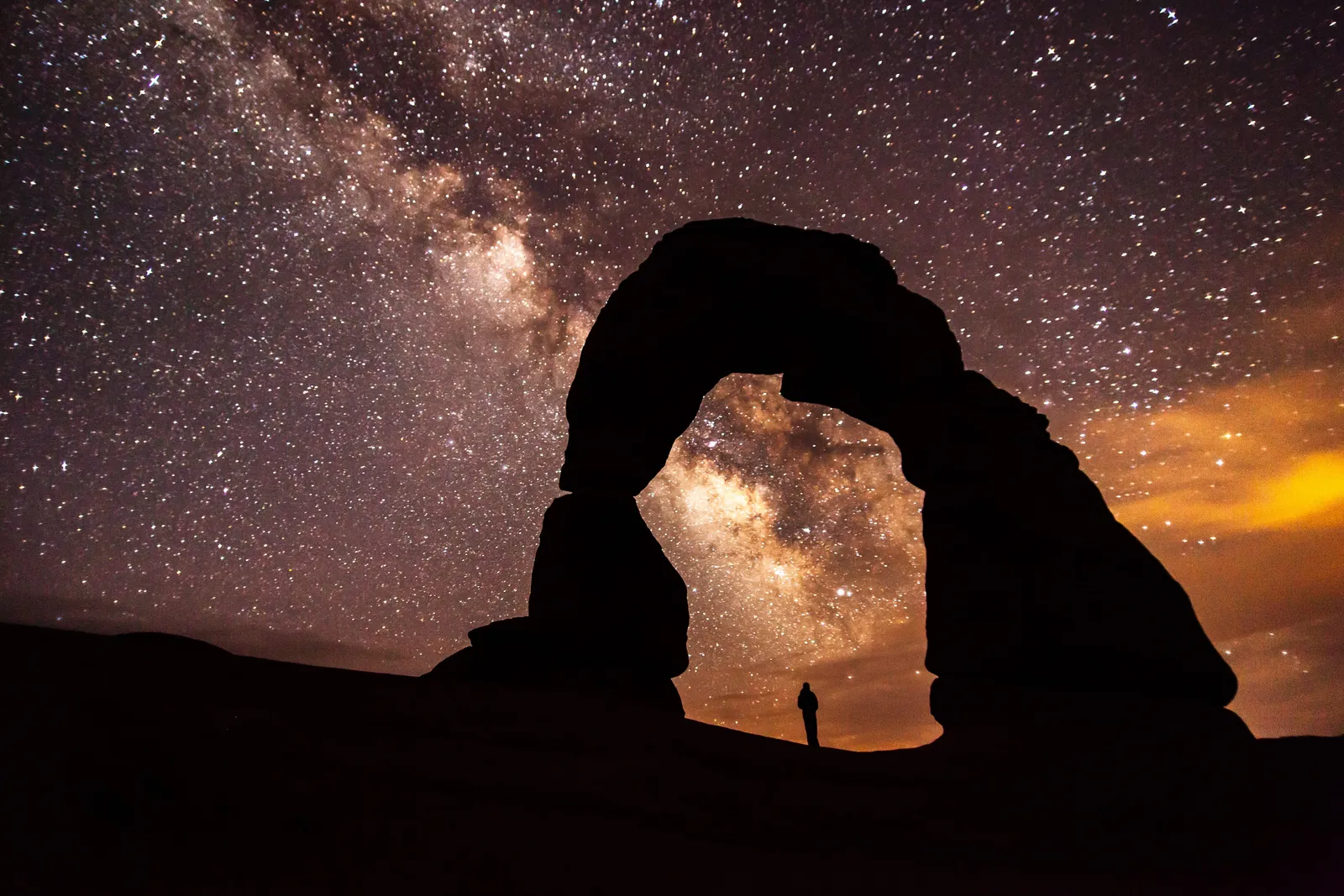
Table of Contents
Stand at North Window Arch at 1am in May and the galactic core rises right through the opening — a river of pale light pouring between 65 million tons of red sandstone. The stars are dense enough to cast a faint shadow on the rock. You can see the Milky Way's dust lanes with the naked eye, and the silence is total except for wind. Arches holds a Bortle Class 2 rating and earned Silver-Tier IDA certification in July 2019 — some of the darkest skies you'll find within a few hours of a major highway. The catch: the park entrance is just 5 miles from Moab, so the darkness builds the deeper you drive. Push past Balanced Rock and you're in genuinely dark-sky territory.
📋 For trail info, seasonal strategy, and trip logistics, see the Arches Complete Guide. This article is purely about the night sky.
Dark Sky Data
Arches National Park is a Bortle Class 2 dark sky site — one of the darkest classifications attainable, and one that the park officially earned with its Silver-Tier DarkSky International certification in July 2019. That certification isn't honorary; it requires ongoing monitoring and lighting management across the park.
Bortle Class: 2
Sky Quality: 20.5–21.0 mag/arcsec² (park interior)
DarkSky Certification: Silver Tier — certified July 2019
Darkest Sites: Windows area, Devils Garden (furthest from entrance)
Light Pollution: Moab dome to the east; western and northern horizon completely clean
What does Bortle 2 actually look like? The Milky Way casts a visible glow across the terrain. You'll see the zodiacal light — a soft cone rising from the western horizon after dusk in spring — without knowing what it is the first time. The dark nebulae (the dusty "gaps" in the Milky Way band) are visible to the naked eye, not just in photos. You can see the Andromeda Galaxy without binoculars if you know where to look. That's what separates a Bortle 2 from the Bortle 4–5 sky most of us shoot in from suburban trailheads.
Drive deeper — past Balanced Rock, into the Windows area, all the way to Devils Garden — and the sky quality improves noticeably. The eastern horizon carries Moab's orange glow no matter where you are, but the western and northern sky is clean from horizon to zenith.
Milky Way Visibility Calendar
At latitude 38.7°N, the galactic core rises in the southeast, transits due south, and sets in the southwest. It peaks at 30–35° above the horizon — meaningfully higher than parks further south like Death Valley, where the core barely clears 23°. That extra altitude matters when you're framing through an arch: more of the core clears the terrain, and you have more sky above the rock to work with.
Month | Core Visible | Hours/Night | Best Window | Notes |
|---|---|---|---|---|
January | No | — | — | Core below horizon all night |
February | Briefly | ~1 hr | Pre-dawn only | Rises ~5am, sets with the sun |
March | Pre-dawn | 2–3 hrs | 3am–dawn | Cold nights; uncrowded park |
April | Yes | 4–5 hrs | Midnight onward | Sweet spot — comfortable temps, long window |
May | Yes | 6–7 hrs | 10pm onward | Core up most of the night |
June | Yes | 7–8 hrs | Dusk to ~1am | Longest nights; plan for early-season crowds |
July | Yes | 6–7 hrs | Dusk to midnight | Peak summer; plan around monsoon moisture |
August | Yes | 5–6 hrs | Dusk to ~11pm | Core sets earlier; southern sky still rich |
September | Yes | 3–4 hrs | Dusk to ~9pm | Andromeda rising in the northeast |
October | Briefly | ~1–2 hrs | Just after dusk | Core low and fading fast |
November | No | — | — | Core below horizon at night |
December | No | — | — | Core below horizon all night |
2026 new moon dates for peak months: April 17 · May 16 · June 14 · July 14 · August 12 · September 10
April 17, 2026 is the standout night. New moon falls right as the galactic core becomes visible from midnight through dawn. Temperatures in the park hover around 50°F — no heat management required, no monsoon moisture, and the crowds haven't arrived yet. If you can only make one trip this year, build it around that date.
One thing to plan for: Moab's light dome sits exactly where the core rises, low in the southeast. When the core is close to the horizon in the 10pm–midnight window, you'll see a warm orange gradient at the bottom of the frame. Some photographers lean into this — the orange glow actually backlights the sandstone beautifully and adds warmth to the rock texture. If you want a clean dark sky behind the core, wait until it climbs higher (past 1am in spring), or compose so the arch or formation blocks the lowest portion of the frame where the glow sits. Locations on the western and northern sides of formations shield you from the dome almost entirely.
Best Shooting Locations
1. North Window Arch
This is the shot. The galactic core passes through the arch opening between midnight and 2am in spring and early summer, and when it does, you get the entire Milky Way framed by 65 feet of red sandstone. The technique is counterintuitive: walk through the arch and set up on the other side, then shoot back through the opening toward the south. From that position, the arch frames the core perfectly. The approach is 0.25 miles one way from the Windows parking area — easy to navigate with a headlamp.
Scout this in daylight first. The shooting position is on rocks on the far side of the arch, and you need to find the exact angle before dark. The arch is wide, which means 14mm won't capture the full composition in a single frame — plan to shoot 3–4 overlapping horizontal frames and merge them as a panorama in Lightroom. It's the standard technique here, and it's what gives the finished image the jaw-dropping scale.
2. Balanced Rock
Balanced Rock is the most accessible shoot in the park — it's a 5-minute walk from the parking lot, and the silhouette reads instantly at night. Stand on the dirt road directly opposite the parking area and you get the La Sal Mountains framing the base of the rock, with open sky above it. Compose with the rock facing west or northwest to keep Moab's dome out of frame — if you face east, the orange gradient from the city sits right behind the formation.
Other photographers are almost always present on a clear spring night. Manage your light discipline — red headlamp only, no white lights. This isn't just NPS policy; it's basic courtesy to everyone else who drove here for dark skies. The dirt road surface is uneven, so bring a tripod with adjustable legs and take your time getting level.
3. Delicate Arch (Lower Viewpoint)
The 3-mile round-trip Delicate Arch trail is exposed slickrock with cairn markers that disappear completely at night. Don't attempt it in the dark unless you've hiked it in daylight first and you've pre-loaded the GPS track on your phone. For most photographers — especially on a first visit — the lower viewpoint overlook (0.1 miles from the parking lot) is the right choice. You get a clean, unobstructed view of the arch with open sky all around, no navigation risk.
If you have hiked the trail before and you're comfortable on slickrock in the dark: yes, the bowl at the top puts you right at the arch for an intimate composition that no viewpoint can replicate. Download the Gaia GPS app, load the trail offline before you leave cell coverage, and make sure your headlamp has fresh batteries. The cairns are nearly invisible at night — GPS is the only reliable way back.
Nikon Z6II Settings
The 500-rule is your starting point for shutter speed: divide 500 by your focal length to get the maximum exposure before star trails appear. At 14mm that's about 35 seconds — but for tack-sharp stars on the Z6II's high-resolution sensor, pull it back to 20–25 seconds. The sensor will reward the sharpness discipline in large prints.
Target | ISO | Aperture | Shutter | White Balance | Lens |
|---|---|---|---|---|---|
Milky Way wide field | 3200 | f/2.8 | 20–25s | 3800–4000K | NIKKOR Z 14-24mm f/2.8 S @ 14mm |
Star trails (interval) | 800–1600 | f/2.8 | 30s/frame | 3800K fixed | NIKKOR Z 14-24mm f/2.8 S |
Moon + landscape | 400–800 | f/2.8–f/4 | 1/125s–1s (blend) | 4500–5000K | NIKKOR Z 24-70mm f/2.8 S |
500-rule quick reference:
14mm → 35s max; use 20–25s for sharp stars
24mm → ~20s max
Z6II field tips:
Long Exposure NR: OFF. It doubles your exposure time, which kills your shooting rhythm. You're in RAW — fix it in post.
IBIS/VR: OFF on a tripod. The stabilization system creates micro-blur on a stable surface. Turn it off before you set up.
Focus manually, 10× live view. Point at a bright star, zoom to 10× on the rear screen, and turn the focus ring until the star is a pinpoint. Lock it — don't touch the focus ring again until you change lenses or focal length.
Shutter release: 2-second timer or remote. Never press the shutter button directly on a tripod. Vibration from your hand is visible in a 25-second exposure.
North Window: shoot a panorama. The arch is too wide for a single 14mm frame from shooting distance. Take 3–4 overlapping horizontal frames and merge in Lightroom's panorama mode. Overlap each frame by 30–40% for a clean stitch.
Red headlamp only. NPS policy at Arches prohibits white lights in dark sky areas. This is enforced, and other photographers will notice. Keep a red headlamp clipped and accessible before you arrive at the location.
What to Photograph (Deep Sky Objects)
The Milky Way core is the main event from April through August. It rises in the southeast as a dense, textured band — not a faint smudge but a three-dimensional structure with visible dark lanes, star clusters, and a bright central bulge. At Arches' latitude, the core climbs high enough above the southern horizon to fill an arch composition from edge to edge. That's what makes North Window so compelling: the core doesn't just peek through the arch opening, it fills it.
Scorpius sweeping the southern horizon in June and July is one of the more dramatic sights you don't need a camera to appreciate — though it photographs beautifully. The constellation's tail curves low above the terrain, and in a Bortle 2 sky the nebulosity around the Scorpion's heart is visible to the naked eye. Frame it wide with a foreground formation and you get the star density of the galactic center plus the hook of the Scorpion's tail in the lower right of the frame.
Zodiacal light in early spring (March–April) is worth going out before dawn specifically to see. It looks like a soft, slightly tilted cone of pale light rising from the eastern horizon — not the Milky Way, which is a band. It's interplanetary dust lit by the sun, and a Bortle 2 sky is where most photographers see it for the first time without knowing what it is. Look east about 90 minutes before dawn. If you've never seen it, it'll stop you cold. It doesn't photograph the same way the Milky Way does — a wide 14mm shot pointed east before dawn, slightly underexposed, is the right approach. Treat it as a bonus on any April or March shoot, not the main target.
Ranger Programs & Astronomy Events
Arches runs ranger-led night sky programs during peak season — typically spring and summer — as part of the NPS Night Skies program. Rangers can also advise on current viewing conditions and the best spots given recent weather and moon phase.
Gear for Astrophotography at This Park
Arches has conditions you don't find at more remote parks: you're close to Moab, which means forgotten gear is retrievable and multiple nights are practical. But the terrain has specific demands — slickrock requires careful footing in the dark, spring nights turn cold fast after warm afternoons, and the Delicate Arch trail is a navigation challenge without preparation.
Red headlamp — NPS prohibits white lights in dark sky areas at Arches, and this is enforced. Carry your red headlamp clipped to your bag before you arrive, not buried inside it.
Extra batteries — Spring nights drop below freezing after midnight at elevation. Cold kills battery life fast; keep spares in a jacket pocket against your body.
Tripod with adjustable legs — The dirt road at Balanced Rock is uneven, and the rock surface at North Window's far side requires full leg independence to get level. A ball head alone won't compensate for sloped terrain.
Gaia GPS — Download the Arches area maps offline at home before you leave cell coverage. Pre-load the Delicate Arch trail, specifically if you're attempting it at night. The free version handles this fine.
Warm layers — Days in April and May feel like summer. Nights after midnight feel like October. Bring a down jacket regardless of how the afternoon feels.
Frequently Asked Questions
What Bortle class is Arches National Park?
Arches is a Bortle Class 2 dark sky site — one of the darkest attainable ratings. The park earned Silver-Tier DarkSky International certification in July 2019. Darkness improves the deeper you go into the park; the Windows area and Devils Garden offer the best conditions.
What's the best month to photograph the Milky Way at Arches?
April is the sweet spot — specifically around the April 17, 2026 new moon. The galactic core is visible from midnight through dawn, temperatures are comfortable, and the park isn't yet at peak summer crowds. May and June are close seconds if your schedule doesn't allow April.
How do you photograph the Milky Way through North Window Arch?
Walk through the arch and set up on the far side, then shoot back through the opening toward the south. The core passes through the arch opening between midnight and 2am in spring. Because the arch is wide, shoot 3–4 overlapping horizontal frames at 14mm and merge them as a panorama in Lightroom — a single frame won't capture the full composition.
What are the starting Nikon Z6II settings for Milky Way photography at Arches?
Start at ISO 3200, f/2.8, and 20–25 seconds at 14mm on the NIKKOR Z 14-24mm f/2.8 S. Set white balance to 3800–4000K, turn off Long Exposure NR and IBIS, focus manually at 10× live view on a bright star, and use a 2-second timer or remote release. Adjust ISO up to 6400 if the histogram is too dark.
Does moon phase matter for Arches astrophotography?
Yes — significantly. A full moon washes out the Milky Way even in a Bortle 2 sky. Plan your shoot within 3–4 days of new moon for the darkest conditions. The 2026 new moon dates for peak season are April 17, May 16, June 14, July 14, August 12, and September 10.
Keep reading
More on this topic from TrailVerse