Death Valley Astrophotography 2026: Bortle 1–2 Skies, Milky Way & Z6II Settings
Bortle 1 darkness at Death Valley: where to shoot the Milky Way, which months are safe, and the camera settings that work on the ground.
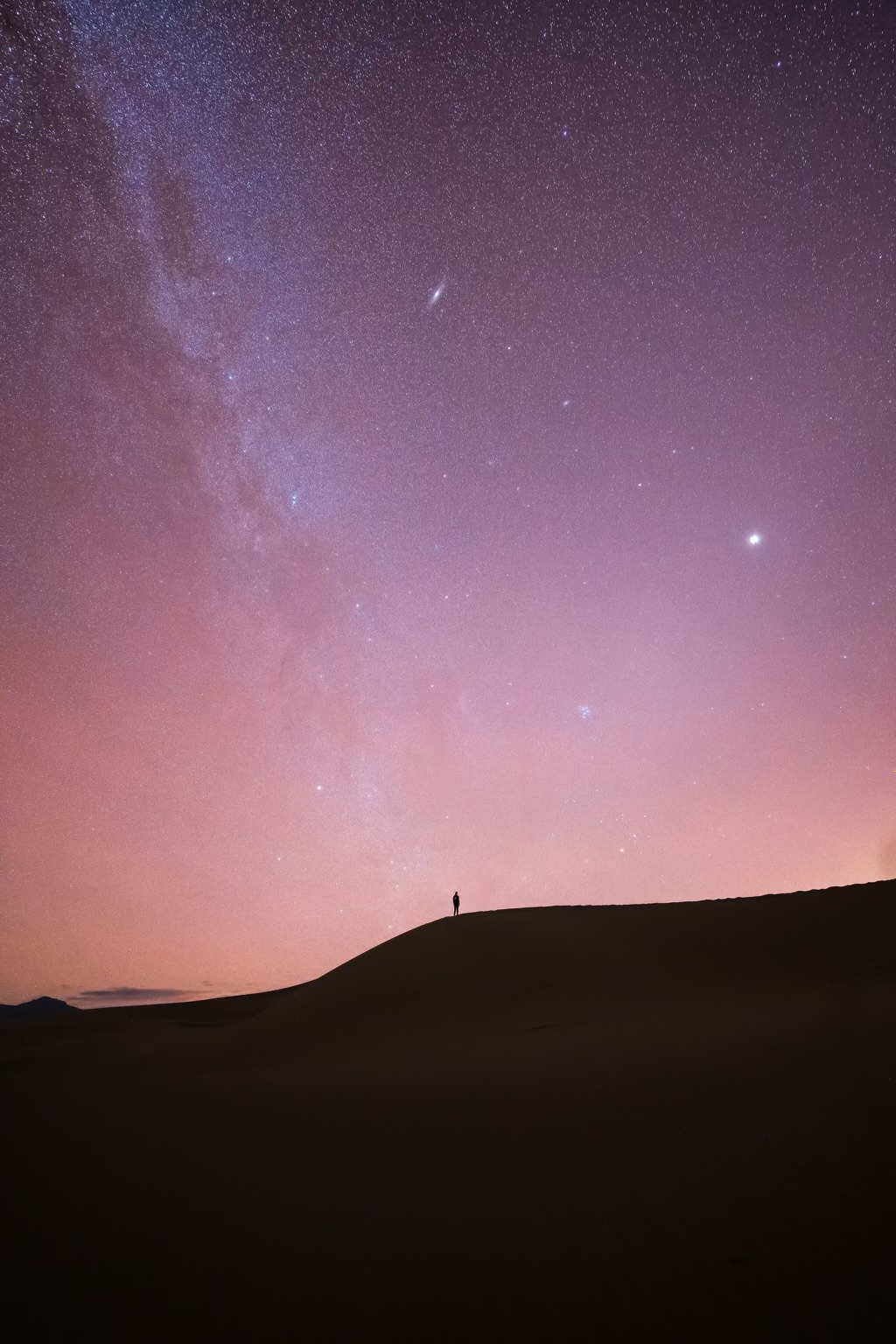
Table of Contents
Stand at the Mesquite Flat Sand Dunes at 2am in April and look up. The Milky Way is not a faint smear — it's a river of light so thick it has visible structure, color gradients from blue-white to warm gold, and dark dust lanes you can trace with your eyes. Look down at the sand. There are shadows. Faint, diffuse, unmistakable shadows cast by the galaxy itself. That's what Bortle Class 1 actually looks like, and it's why Death Valley belongs on every serious astrophotographer's list.
This is the darkest park in the contiguous United States, Gold-Tier certified by the International Dark Sky Association since 2013. The Milky Way window runs from late February through October, peaking April through July. For the right location, the right settings, and the right nights — this guide covers all of it.
📋 For trail info, seasonal strategy, and trip logistics, see the Death Valley Complete Guide. This article is purely about the night sky.
Dark Sky Data
Death Valley National Park holds a Bortle Class 1–2 rating, with interior locations reaching true Bortle 1 — the highest certification tier available from DarkSky International.
Bortle Class: 1–2 (interior reaches true Bortle 1)
Sky Quality: 21.45–21.68 mag/arcsec² average (2016 Death Valley Annual Report)
DarkSky Certification: Gold Tier — certified 2013 (DarkSky International)
Darkest Sites: Racetrack Playa, Mesquite Flat Dunes interior
Light Pollution: Las Vegas dome ~100 miles east/southeast; western and northern horizon completely clean
What does Bortle Class 1 actually mean in practice? You can see the zodiacal light — a cone of interplanetary dust stretching up from the horizon — with the naked eye. The Andromeda Galaxy is obvious without binoculars. Stars near the horizon twinkle with color. The sky is so full of light that orienting yourself takes a moment — the familiar star patterns are buried in thousands of fainter stars you've never seen before.
Milky Way Visibility Calendar
At Death Valley's latitude (36°N), the galactic core rises in the southeast, transits due south, and sets in the southwest. The low arc through the southern sky matters for shooting in canyons and valley floors — you'll lose it behind terrain early if you're in a hemmed-in location. Plan your framing accordingly: open southern horizons are key.
The Las Vegas light dome sits roughly 100 miles to the east/southeast. It's visible as a glow on the eastern horizon on humid nights but doesn't affect the core shooting directions — west and north are completely clean from all locations in the park.
Month | Core Visible | Hours/Night | Best Window | Notes |
|---|---|---|---|---|
January | No | — | — | Core below horizon all night |
February | Briefly | ~1–2 hrs | Pre-dawn only (4–6am) | Brief appearance; not worth the drive unless you're already there |
March | Yes | ~3–4 hrs | 3am–dawn | Pre-dawn only; improves rapidly through the month |
April | Yes | ~5–6 hrs | Midnight–dawn | Core clears horizon by midnight; great superbloom combo in 2026 |
May | Yes | ~7–8 hrs | 10pm–dawn | Core visible most of the night; best wildflower crossover |
June | Yes | ~8–9 hrs | Dusk–dawn | Peak month; core visible from dusk; summer heat requires planning |
July | Yes | ~7–8 hrs | Dusk–1am | Core sets earlier; Scorpius/Sagittarius high in south |
August | Yes | ~5–6 hrs | Dusk–midnight | Core setting earlier; still excellent |
September | Yes | ~3–4 hrs | Dusk–10pm | Window shortening; pleasant temperatures returning |
October | Briefly | ~1–2 hrs | Just after dusk | Catch it early or miss it |
November | No | — | — | Core below horizon; winter galaxy overhead |
December | No | — | — | Core below horizon |
2026 New Moon Dates
Plan your shoot within 3–4 days either side of these dates for the darkest skies:
April 17 — prime window, superbloom still active at higher elevations
May 16 — excellent conditions, warm nights, long visibility window
June 14 — peak Milky Way season, hottest nights in the valley
July 14 — galactic core high in the south, best for wide compositions
August 12 — temperatures easing, shorter window
September 10 — final good window before the core fades
April 17 is the standout date for 2026. The superbloom at higher elevations is still active, temperatures are manageable, and the galactic core is visible from midnight to dawn. A wildflower foreground with the Milky Way overhead is a once-in-a-decade shot.
Best Shooting Locations
1. Mesquite Flat Sand Dunes
This is the best natural foreground in the park. Rippled dune textures catch starlight differently than flat terrain — the crests glow, the troughs shadow, and the geometry shifts with every step. The dunes sit just off Stovepipe Wells with a short walk from the parking lot, making it accessible without a long approach hike in the dark.
Scout in daylight and drop a GPS pin on your exact shooting spot. Getting disoriented in the dunes at 2am is far more common than it sounds — the terrain is featureless in every direction and looks identical under red headlamp. Shoot toward south or southwest for the cleanest, darkest sky. The Panamint Range frames the western horizon beautifully on a moonlit foreground blend.
2. Badwater Basin
The salt polygons at Badwater are unlike any other astrophotography foreground on earth. Geometric, pale white, and almost perfectly flat, they reflect starlight like a matte mirror. After significant rainfall, a thin sheet of water covers the flats and turns into a true mirror — the Milky Way reflecting back from 282 feet below sea level.
Walk at least 10 minutes past the crowded section near the road sign into the undisturbed polygon field. The trampled area near the boardwalk is wrecked for foreground detail. The pristine flats further in are what the photos look like. The Panamint and Amargosa ranges on either side of the valley block some of the low horizon glow, which is a minor constraint — but the central sky overhead is completely open.
3. Dante's View
Dante's View sits at 5,475 feet — high enough to clear the atmospheric dust and haze that builds up in the valley at night. The view west from the overlook takes in the entire width of Death Valley, with Badwater Basin glowing faintly 5,000 feet below. Shooting west from Dante's View means a completely dark horizon with nothing between you and the Pacific.
A paved road reaches the overlook (no trailers on the final mile), which makes setup easy. Dress for serious cold, even in summer. The temperature at 5,475 feet is 20–30°F colder than the valley floor, and the wind at this exposed ridgeline is relentless. Bring more layers than you think you need. The site has one of the most dramatic perspectives in any dark sky park in the country.
4. Racetrack Playa — The most remote shoot in the park. 27 miles of unpaved road, high-clearance vehicle required, zero cell coverage. The dry lakebed is completely flat with 360° open horizon — no terrain blocking any direction. The famous sailing stones make for a unique foreground. Only attempt this if you've downloaded offline maps and have a full tank of gas.
Nikon Z6II Settings
The 500 Rule gives you a starting point for shutter speed: divide 500 by your focal length. At 14mm, that's roughly 35 seconds. Use 20–25 seconds instead — the Z6II's high-resolution sensor resolves star trails at exposures that look fine on older cameras. Tack-sharp stars on a 24-megapixel file require more conservative shutter speeds than the rule suggests.
Target | ISO | Aperture | Shutter | White Balance | Lens |
|---|---|---|---|---|---|
Milky Way wide field | 3200 | f/2.8 | 20–25s | 3800–4000K | NIKKOR Z 14-24mm f/2.8 S @ 14mm |
Star trails (interval) | 800–1600 | f/2.8 | 30s/frame | 3800K fixed | NIKKOR Z 14-24mm f/2.8 S |
Moon + landscape | 400–800 | f/2.8–f/4 | 1/125s–1s (blend exposures) | 4500–5000K | NIKKOR Z 24-70mm f/2.8 S |
Z6II Tips
Long Exposure NR: OFF. With this on, the camera shoots a blank "dark frame" for every exposure — doubling your time per shot. You're shooting RAW and doing noise reduction in post anyway.
IBIS/VR: OFF on tripod. In-body stabilization can create subtle micro-blur when the camera is mounted on a stable tripod. Switch it off before your first exposure.
Focus: Manual with 10× live view. Point at a bright star, zoom to 10× in live view, turn the focus ring until the star is a sharp point of light. Lock focus and don't touch it again for the rest of the session.
Release: 2-second self-timer or MC-DC2 remote. Pressing the shutter button physically vibrates the camera and ruins pinpoint stars. Use either method — never press the button directly.
Foreground blending. Shoot your sky frame at 20–25 seconds, ISO 3200–6400. Then shoot a separate foreground frame at ISO 800, 30–60 seconds with the same composition. Blend the two in Lightroom using a gradient mask — this gives you a clean, low-noise foreground and a detailed sky.
NPS light painting policy. The National Park Service prohibits light painting on rock formations and salt flats at Death Valley. Use a red headlamp only. White flashlights and light painting onto natural surfaces will get you cited.
Arrive before dark with gear already packed. In summer the valley floor is dangerous in the hour before sunset — load your bag at the hotel, drive to your location before dusk, and let equipment acclimate while you scout your composition
What to Photograph (Deep Sky Objects)
The Andromeda Galaxy is the furthest thing you'll see without a telescope. It looks like an elongated, fuzzy smudge — more oval than round, slightly brighter at the center, extending about the width of your fist held at arm's length. In good conditions at Bortle 1, it's clearly visible with the naked eye in the northeastern sky from late summer through early winter. Point your camera at it with a 14mm lens and you'll get it and the surrounding star field in a single frame.
The Lagoon Nebula sits just above the spout of the "Teapot" asterism in Sagittarius, which rises in the southeast in summer. It looks like a soft, pale smudge — slightly pink if you push the warmth in post, though the eye picks it up as grayish-white. It's one of the few nebulae visible without a telescope, and from Bortle Class 1. Find the Teapot asterism in Sagittarius and look just above the spout — the nebula sits roughly 8° north of the tip, visible as a soft pale smudge against the dense star field.
The Scorpius and Sagittarius star fields are the richest section of the entire night sky from dark-sky sites. This is where the galactic core is densest — billions of stars packed into a band of light so thick it looks almost three-dimensional. No camera settings required: just point your widest lens south between June and August, expose for 20 seconds, and you'll have the shot that other photographers travel internationally to get.
Night Sky Programs at Death Valley
Park rangers run constellation tours and telescope viewings at Furnace Creek throughout the season — typically at 7:30, 8:30, and 9:30 pm on clear nights. These are free, open to all visitors, and genuinely worth doing before your first solo shoot. Rangers know current conditions better than any app — worth asking which sections of the park are clearest before you drive an hour into the backcountry.
The Death Valley Dark Sky Festival runs every February and is one of the best astronomy public events in the western US — NASA, Caltech, SETI Institute, and the Las Vegas Astronomical Society all participate. The 2025 festival drew 6,824 attendees, the highest in its 13-year history. Check the NPS website for the next dates and to reserve free keynote tickets, which go fast.
Gear for Astrophotography at This Park
Bring more layers than you think you need. The valley floor cools dramatically after midnight. Dante's View sits at over 5,000 feet and will be genuinely cold — jacket, hat, and gloves cold — even in June. Thermal base layers pack small and save shoots.
Red headlamp — the NPS prohibits white lights and light painting on natural surfaces at Death Valley and this is enforced. Red light protects your night vision and keeps you from ruining other photographers' long exposures. Clip it to your bag before you leave the car — not buried inside it.
Extra batteries — cold temperatures drain lithium batteries faster than you expect. Bring at least two fully charged Z6II batteries and keep the spare in an inside jacket pocket to stay warm. A multi-hour session at Dante's View in March can kill a battery in under 90 minutes.
Tripod — a 20-second exposure on sand dunes or salt flats at 14mm requires a completely stable platform. The uneven surface at Mesquite Flat and the polygon ridges at Badwater both demand fully adjustable legs — a ball head alone won't compensate for sloped terrain. Set up and level before dark so you're not fumbling in the dunes at 2am.
Remote shutter release — pressing the shutter button directly on a tripod transmits vibration that shows up as blur in a 20-second exposure. The Nikon MC-DC2 plugs straight into the Z6II with zero lag, no batteries, no pairing — just trigger and shoot. Non-negotiable for pinpoint stars on a high-resolution sensor.
Gaia GPS — download offline maps before you leave cell service. Backcountry roads in Death Valley have zero cellular coverage — the road to Racetrack Playa is 27 miles of unpaved track with nothing. Don't navigate it at night without an offline map and a high-clearance vehicle.
Frequently Asked Questions
What is the Bortle Class of Death Valley?
The interior of Death Valley reaches Bortle Class 1 — the darkest designation that exists. Locations like Racetrack Playa and the Mesquite Flat Dunes interior are among the darkest accessible spots in the lower 48 states. The park was Gold-Tier certified by DarkSky International in 2013.
What is the best month to photograph the Milky Way at Death Valley?
April through July, with June and July offering the longest visibility windows (dusk to around 1–2am). April 2026 is exceptional — the galactic core is visible from midnight onward, temperatures are still manageable, and the wildflower superbloom at higher elevations creates a rare foreground opportunity. Plan around the April 17 new moon.
What is the best shooting location at Death Valley?
For most photographers, Mesquite Flat Sand Dunes is the right starting point — dramatic foreground, easy access, no navigation risk in the dark. Badwater Basin after rainfall is the most unique shot in the park if conditions align. Dante's View gives you the best raw sky quality due to elevation and cleaner air, but requires serious cold-weather prep and is best for experienced shooters who've already done the other two.
What Z6II settings should I start with for the Milky Way?
Start at ISO 3200, f/2.8, 20 seconds, with white balance at 3800K. That's a safe baseline for the NIKKOR Z 14-24mm f/2.8 S at 14mm. Review your first frame at 100% crop and adjust ISO up (toward 6400) if you need more brightness, or reduce shutter to 15–18 seconds if stars look trailed. Make sure Long Exposure NR and IBIS are both off.
Does moon phase matter for Milky Way photography?
Yes — significantly. A full moon lights up the desert beautifully but completely washes out the Milky Way. Shoot within 3–4 days of new moon for darkest skies. The 2026 new moon dates that fall in the peak Milky Way window are April 17, May 16, June 14, and July 14. The April and May dates offer the most comfortable shooting temperatures.
Keep reading
More on this topic from TrailVerse