Glacier Astrophotography 2026: Bortle 1–2 Skies, Milky Way & Aurora
Glacier is one of the few places in the lower 48 where you can shoot the Milky Way and the northern lights on the same night. Bortle 1–2 skies, aurora forecasting with Kp thresholds, Nikon Z6II settings, a 2026 Milky Way calendar, and the 3 best shooting locations from Bowman Lake to Many Glacier.
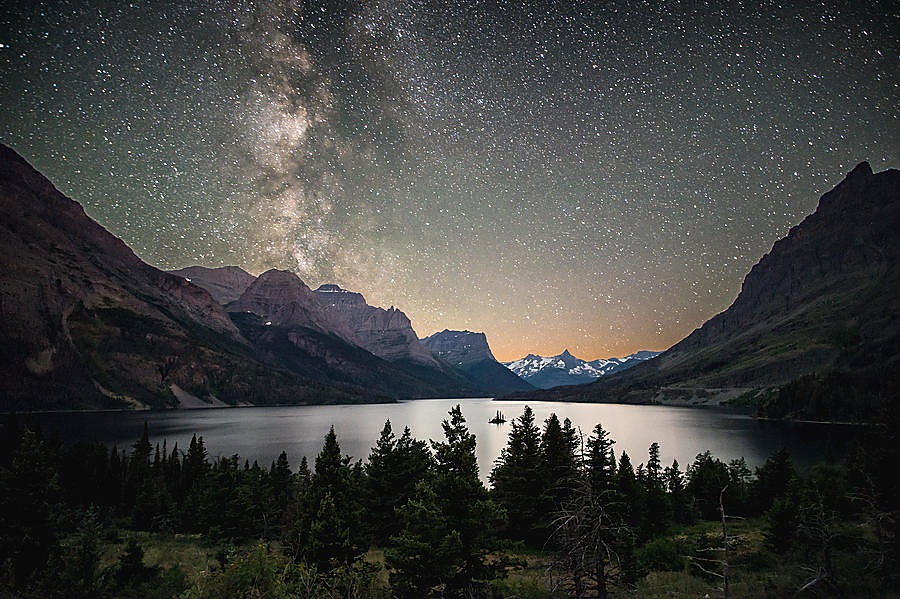
Table of Contents
Glacier is one of the few places in the lower 48 where you can photograph the Milky Way and the northern lights on the same night. The skies here are Bortle Class 1–2 — among the darkest in the country — and together with Canada's Waterton Lakes, Glacier forms the world's first transboundary International Dark Sky Park.
The park sits at 49°N, which changes how you shoot. The Milky Way core stays low on the southern horizon — about 20° at its highest — so your best shots pair it with mountain peaks and lake reflections instead of shooting straight up. And that northern latitude is exactly why aurora is a real possibility here.
This guide covers the three best shooting locations, exact Nikon Z6II settings, a 2026 Milky Way calendar, and how to forecast aurora.
📋 For trail info, seasonal strategy, and 2026 access changes (new shuttle, Logan Pass parking rules), see the Glacier National Park Complete Guide. This article is purely about the night sky.
Dark Sky Data
Glacier National Park and Canada's Waterton Lakes National Park together form the world's first transboundary International Dark Sky Park, certified by DarkSky International in 2017. The Bortle rating is a separate measurement: the park interior measures Class 1–2, with the remote North Fork corridor the darkest.
Bortle Class: 1–2 (park interior); 2–3 near developed areas (Apgar, St. Mary)
Sky Quality: ~21.7–22.0 mag/arcsec² at the darkest North Fork sites; ~21.0–21.5 near developed areas
DarkSky Certification: International Dark Sky Park — world's first transboundary, certified 2017
Darkest Site: Bowman Lake / Kintla Lake, North Fork corridor
Light Pollution: Kalispell/Whitefish (WSW, ~25–30 miles) is the only meaningful dome. The east side of the park (Many Glacier, St. Mary, Two Medicine) puts the Continental Divide between you and it. North, south, and east horizons are essentially pristine, with Waterton's protected dark sky extending across the border.
At this darkness, the sky has actual texture. The dark dust rifts physically split the galactic band into two visible streams. Airglow makes the horizon glow faintly with zero city lights nearby. The zodiacal light after dusk is unmistakable — a tilted pyramid of light climbing from the western horizon. This is what genuinely dark skies look like, and it's rare.
Milky Way Visibility Calendar
From 49°N, the galactic core rises in the southeast, arcs low across the south, and sets in the southwest — staying close to the horizon the entire time. That's a creative constraint that forces foreground thinking, and Glacier's foregrounds are the best in the system.
The real constraint is June twilight: at this latitude, the sky doesn't reach full astronomical darkness until 11pm or later in June, compressing your shooting window to as little as two hours. Plan around the July and August new moons instead.
Month | Core Visible | Best Window | Notes |
|---|---|---|---|
January–March | No | — | Core below horizon all night |
April | Pre-dawn only | 3–5 AM | Very short window, cold |
May | Pre-dawn | 2–5 AM | Expanding window; many roads still closed |
June | Late night | ~11:30 PM–3:30 AM | Twilight compresses window to 2–3 hrs |
July | Most of night | ~11 PM–4 AM | Best month — full darkness, core at peak, park open |
August | Evening–pre-dawn | ~10 PM–4 AM | Also excellent; Perseid meteor shower Aug 12 |
September | Evening | 9 PM–2 AM | Longer nights; weather more variable |
October | Brief evening | 8–10 PM | Core low and descending; season closing |
November–December | No | — | Below horizon |
2026 new moon dates:
July 14 (window: July 10–18) — best month overall
August 12 (window: Aug 8–16) — new moon coincides with the Perseid meteor shower peak; the best single night of 2026
September 11 (window: Sep 8–15) — longer nights, aurora season picking up
For the cleanest Milky Way sky, shoot south and southeast — and if you're on the west side, avoid compositions pointing toward Kalispell's faint WSW glow. From the east side it's a non-issue.
Best Shooting Locations
1. Bowman Lake (North Fork / Polebridge)
Bowman Lake is the darkest accessible location in the park, and it earns the designation. The lake sits in Glacier's remote northwestern corner, reached via roughly 30 miles of mostly unpaved road from Columbia Falls through the tiny community of Polebridge. The lake faces east — in summer evenings you're shooting the Milky Way core rising over the mountains, one of the most dramatic low-horizon compositions anywhere in the park. For aurora, turn 180° and face north from the same shoreline.
There's zero ambient lighting, no cell service, and active grizzly habitat — bear spray on your hip is mandatory, not optional. Campers at Bowman Lake Campground have legal overnight access; day visitors should arrive by dusk and plan the drive out carefully. High-clearance is recommended; a careful 2WD driver can make it in dry conditions, but a flat tire at midnight on this road is not a situation you want.
2. Many Glacier / Swiftcurrent Lake
The Many Glacier area is the most iconic astrophotography location in the park for sheer foreground quality. The Many Glacier Hotel and the reflected silhouettes of Grinnell Point, Mount Wilbur, and Swiftcurrent Mountain are world-class compositional subjects at Bortle 2 — and a calm lake surface doubles every star you capture. Shoot south and southeast over Swiftcurrent Lake for the core; the Continental Divide blocks Kalispell's glow entirely from this side.
Many Glacier is fully accessible in 2026 following 2025 construction. Access via Many Glacier Road from Babb, MT; there's a campground on site. The hotel's ambient light is manageable — position so it falls behind you. For star trails, face north across the lake with Polaris framed above the peaks — at 49°N latitude, Polaris sits 49° above the horizon, about as well-placed for circular trail compositions as you'll find in any national park.
3. Logan Pass (Going-to-the-Sun Road, 6,646 ft)
At 6,646 feet, Logan Pass gives you open 360° alpine tundra — no trees, no valley walls, just mountain silhouettes on every horizon. You're above the valley haze, and the NPS hosts official Star Parties here in summer with Big Sky Astronomy Club telescopes.
The critical 2026 access note: a 3-hour parking limit at Logan Pass takes effect July 1 and applies around the clock. Plan a tight, efficient shoot: arrive around 10:30pm after the road quiets down, shoot a focused window from 11pm to about 1:15am, and be driving down inside your three hours. Scout your composition in daylight earlier in the trip so you're not burning your window searching for a frame in the dark. For an all-night session, Logan Pass isn't your spot in 2026 — that's what Bowman Lake and Many Glacier are for. Overnight stays require a backcountry permit. Confirm current conditions at nps.gov/glac before heading up; the shuttle doesn't run at night, so you're driving yourself.
Nikon Z6II Settings
The Z6II is an outstanding body for Glacier, and Bortle 1–2 skies work in your favor — you don't need to push ISO to extremes. ISO 3200 at f/2.8 produces clean results here that would require much higher ISO from a suburban sky with a slower lens.
500-rule shutter calculations (NIKKOR Z 14-24mm f/2.8 S):
500 ÷ 14mm = 35 seconds max — use 20–25 seconds for sharper stars
500 ÷ 20mm = 25 seconds
500 ÷ 24mm = 20 seconds
One latitude note: with the core transiting at only ~20° above the southern horizon, you need width to capture the arc plus foreground — 14–20mm is essential here, and 24mm will crop the core. Go wide.
Scenario | ISO | Aperture | Shutter | White Balance | Lens |
|---|---|---|---|---|---|
Milky Way Wide Field | 3200 | f/2.8 | 20–25s | 3800–4000K | NIKKOR Z 14-24mm f/2.8 S @ 14mm |
Star Trails (N-facing, Polaris at 49°) | 800–1600 | f/2.8 | 30s × 200–400 frames | 3800K fixed | NIKKOR Z 14-24mm f/2.8 S |
Aurora (active display, Kp 5+) | 1600–3200 | f/4 | 3–8s | 3500–4000K | NIKKOR Z 14-24mm f/2.8 S @ 14mm |
Aurora (faint, Kp 4) | 3200 | f/4 | 10–20s | 3500–4000K | NIKKOR Z 14-24mm f/2.8 S |
Moon + Lake Reflection | 400–1600 | f/4–f/8 | 1–15s | 4500–5500K | NIKKOR Z 24-70mm f/2.8 S |
Z6II-specific tips:
Long Exposure NR: OFF. Doubles your time between frames. Handle noise with dark frames in post instead.
IBIS/VR: OFF on tripod. Active stabilization introduces micro-vibration on a stable platform; turning it off gets you sharper star points.
Focus: manual, 10× Live View on a bright star. At this darkness, there are so many stars that autofocus gets confused. Zoom all the way in on a bright one and adjust until it's a clean pinpoint, then lock the ring.
Release: 2-second self-timer or remote shutter. Camera shake from the shutter button is visible at 20-second exposures.
Lake reflections: shoot the first hour after astronomical darkness. At Bowman and Swiftcurrent, still water doubles the sky; wind kills it. Get your reflection frames early while the surface holds.
NPS policy: no light painting on rock faces or vegetation. Keep your headlamp pointed at your gear and the ground, red mode only.
What to Photograph (Deep Sky Objects)
The Andromeda Galaxy rises in the northeast by midnight in August, visible to the naked eye as a soft, elongated smudge — and spanning several full-moon widths in a long exposure. By September it climbs high enough that a 25-second Z6II frame shows the hazy disc and a hint of dust lane. A whole other galaxy, captured without a telescope.
The North America Nebula sits next to Deneb in the Summer Triangle, almost directly overhead from Glacier in summer. In binoculars it's a faint continent-shaped glow; near-zenith position means you're shooting through the thinnest possible slice of atmosphere — the sharpest, cleanest frames of the night.
The Great Rift is the feature first-timers don't expect: the dark dust lanes physically splitting the bright galactic band into two streams. At Glacier's darkness, the contrast is stark enough to see with the naked eye before you touch your camera.
Aurora Borealis at Glacier
Glacier is one of the best aurora destinations in the lower 48, and that's geography, not marketing. At 49°N, the park sits near the southern edge of the auroral oval during moderate geomagnetic storms — you don't need an extreme solar event to see real curtains here. The north horizon looks across Waterton's protected dark sky territory with essentially zero development, giving you an unobstructed view from horizon to zenith. Solar activity remains elevated near the Solar Cycle 25 maximum, making 2026 one of the better aurora windows at this latitude in years.
Kp thresholds for Glacier:
Kp Level | What You'll See |
|---|---|
Kp 4 | Faint glow on northern horizon; camera clearly records it; barely naked-eye |
Kp 5 (G1 storm) | Active curtains, green bands — excellent for photography |
Kp 6–7 | Overhead arcs, greens with purple and pink fringes — stunning |
Best aurora locations:
Lake McDonald / Apgar — north-facing lakeshore, excellent reflections, easiest access from West Glacier
Bowman and Kintla Lakes — darkest north horizon in the park, zero ambient light, maximum drama
Many Glacier / Swiftcurrent Lake — north-facing shoreline with the hotel as an optional foreground element
Best season: August and September — nights are genuinely dark from 10pm onward and the park is fully accessible. June and July twilight at 49°N limits aurora viewing to the small hours.
How to forecast: Use the NOAA Space Weather Prediction Center 30-minute aurora forecast as your primary tool, and set push alerts on the My Aurora Forecast app for Kp ≥ 4 while you're at the park — that gives you 20–30 minutes of warning to get positioned.
The double-feature night: during a Kp 5+ storm on a moonless August or September night, the Milky Way arcs across the southern sky while aurora lights the north — both visible from the same shoreline. Shoot portrait orientation, rotate between south and north, and don't sleep.
Ranger Programs & Astronomy Events
The NPS astronomy programs at Glacier are genuinely excellent and worth planning around.
Logan Pass Star Parties run roughly once a month July through September. Tickets are $5 per vehicle and go on sale the day before each event at the St. Mary and Apgar Visitor Centers — they sell out, so buy the morning they release. All participants must arrive by 9:30pm; the event starts at 10pm. The 2025 dates were July 25 and August 22; 2026 dates follow the same pattern — check the NPS astronomy page as summer approaches. Big Sky Astronomy Club volunteers bring telescopes and know this sky intimately.
Nightly astronomy programs run at Apgar and St. Mary Visitor Centers through July and August, dusk to midnight, free with no tickets required. The standout is the Dusty Star Observatory at St. Mary — a 20-inch PlaneWave telescope feeding live deep-sky views to exterior 55-inch monitors, funded by the Glacier National Park Conservancy. It's the best public telescope experience in any national park in the region.
Astronomy Week runs in early September (since 2024) — daytime solar viewing, observatory tours, astrophotography workshops, NASA guest scientists, and a final Logan Pass Star Party to close the season. If your trip is flexible, the first week of September stacks dark skies, aurora season, and the full program calendar.
Gear for Astrophotography at Glacier
Glacier's logistics demand more preparation than most parks. Nights at Logan Pass in July regularly drop to 32°F, the Bowman Lake road is unlit and remote, and you're in active grizzly habitat at every dark-sky location. Gear up for the environment, not just the shot.
Counter Assault Bear Spray — you're in grizzly country in the dark, when bears are most active. Wear it on your hip, never buried in your pack. TSA prohibits flying with it — buy ahead for road trips or rent in West Glacier on arrival.
Petzl Tikka CORE headlamp — red mode only at every shooting location: it preserves your night vision, protects other photographers' exposures, and keeps you compliant with the park's no-light-painting policy. The 450-lumen white mode handles the Bowman Lake road approach and bear-country situational awareness when you need it. Rechargeable via USB.
Manfrotto Befree Advanced tripod — lakeshore gravel at Bowman and Swiftcurrent is uneven, and alpine wind at Logan Pass will shake a flimsy travel tripod through a 25-second exposure. The lever-lock legs deploy fast when you're racing the aurora alert, and it packs small enough for the unpaved-road drive. Hang your bag from the center column in wind.
Nikon EN-EL15c batteries (2-pack) — 32°F nights kill lithium batteries fast, and a Z6II can die in 90 minutes at Logan Pass. The EN-EL15c is the native battery; third-party clones underperform in cold. Keep the spare in an inside pocket against your body.
JJC wireless intervalometer remote — vibration-free triggering for 25-second exposures, plus programmable intervals for the 200–400 frame star-trail stacks that Polaris-at-49° compositions deserve. Wireless means you can wait in the warm car during a long sequence — a real benefit at Glacier temperatures.
PhotoPills — use the AR Milky Way planner to pre-visualize exactly where the core rises over Grinnell Point or the Bowman Lake skyline before you commit to the drive. Pair with the free NOAA aurora forecast and Stellarium for object positions.
Frequently Asked Questions
What Bortle class is Glacier National Park?
The park interior rates Bortle Class 1–2, with the darkest skies in the remote North Fork corridor near Bowman and Kintla Lakes. Developed areas like Apgar and St. Mary run Bortle 2–3. Together with Canada's Waterton Lakes, Glacier forms the world's first transboundary International Dark Sky Park, certified in 2017.
What's the best month to photograph the Milky Way at Glacier?
July — the park is fully open, astronomical darkness arrives by 11pm, and the core is at its peak position. August is a close second and adds the Perseids; the August 12, 2026 new moon coincides directly with the Perseid peak, making it the best single night of the year. Avoid June: twilight at 49°N compresses the window to barely two hours.
What Nikon Z6II settings should you use for the Milky Way at Glacier?
Start at ISO 3200, f/2.8, 20–25 seconds at 14mm on the NIKKOR Z 14-24mm f/2.8 S, white balance fixed at 3800–4000K. Glacier's dark skies mean you don't need to push the sensor hard. Focus manually with 10× Live View on a bright star, turn Long Exposure NR off, and disable IBIS on the tripod.
What's the single best location in Glacier for astrophotography?
Bowman Lake in the North Fork — the darkest skies in the park, an east-facing lake for Milky Way reflections, and a north shore for aurora. The trade-off is 30 miles of mostly unpaved road and complete remoteness. For iconic foreground with easier access, Many Glacier's Swiftcurrent Lake delivers world-class mountain reflections with campground access.
Can you see both the Milky Way and the Northern Lights on the same night at Glacier?
Yes, and it happens. The Milky Way arcs across the southern sky while aurora lights the north — both visible from the same shoreline. Best odds: a Kp 5+ geomagnetic storm on a moonless August or September night. Set your aurora app to alert at Kp 4 so you're positioned before the display peaks, then rotate between south and north as conditions demand.
🗺️ Planning your trip? TrailVerse's AI trip planner builds custom itineraries based on your dates, interests, and pace.
Keep reading
More on this topic from TrailVerse