Grand Canyon Astrophotography 2026: Bortle 2 Skies, Milky Way & Z6II Settings
The Grand Canyon is a certified Bortle 2 dark sky park where the Milky Way casts a faint shadow — and you can drive right up to it. Nikon Z6II settings, a 2026 Milky Way calendar with new moon dates, and the 3 best shooting locations from Lipan Point to the 3,000-foot drop at Toroweap.
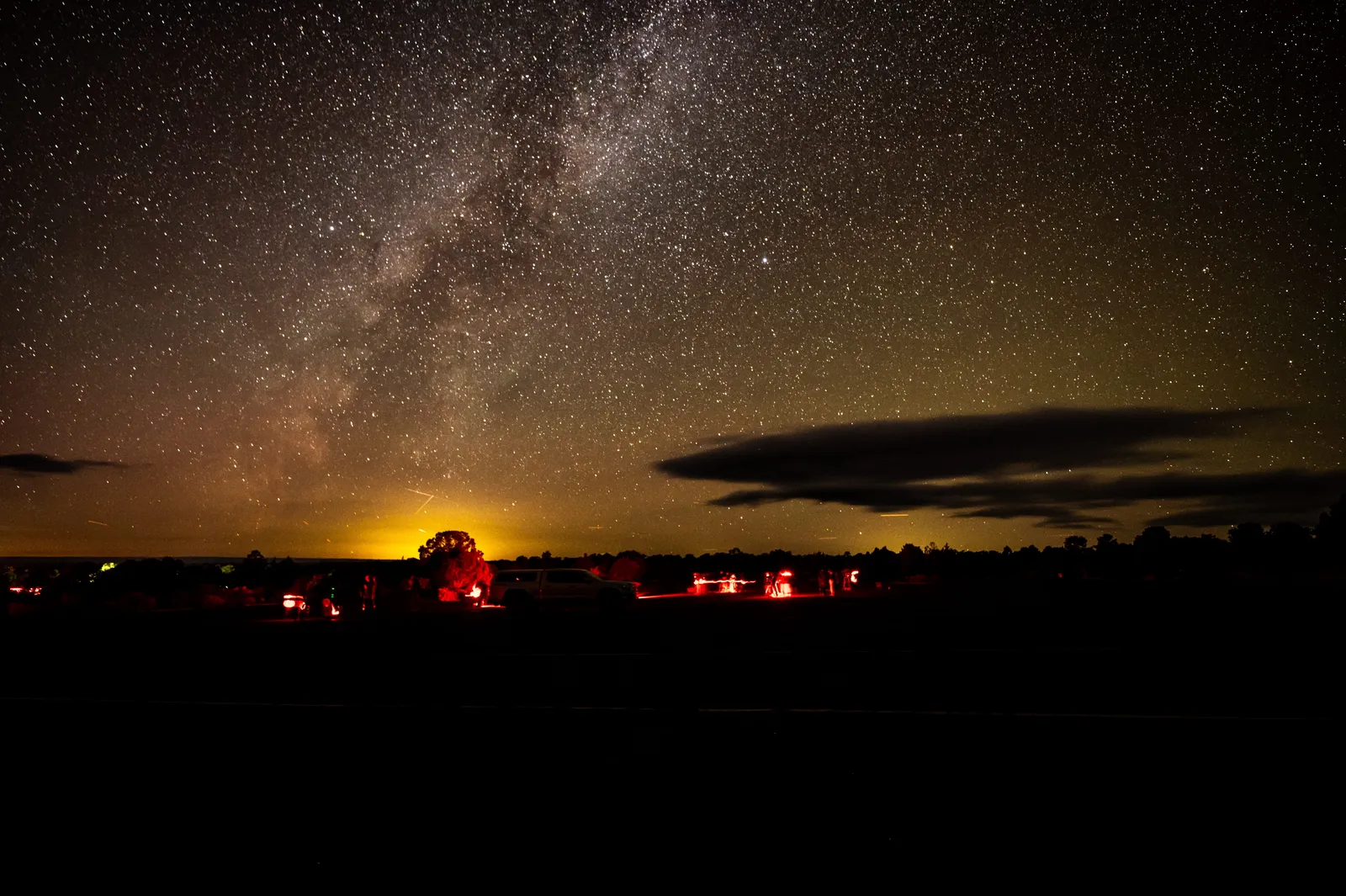
Table of Contents
Walk up to the South Rim at 2 a.m. in July, turn off your headlamp, and give your eyes thirty seconds. The Milky Way doesn't slowly appear — it shows up all at once, thick and three-dimensional, arcing from one canyon wall across to the other. Look straight up and the dust lanes are obvious. Look south and the bright core hangs over the canyon, bright enough to throw a faint shadow if you hold your hand against it.
That's what Bortle Class 2 looks like, and the Grand Canyon has it above a paved, drive-up overlook — one of the darkest skies you can reach without leaving the pavement anywhere in the continental US. This guide covers where to shoot, the exact settings for a Nikon Z6II, and a 2026 calendar built around the new moons.
📋 For trail info, seasonal strategy, and trip logistics, see the Grand Canyon Complete Guide. This article is purely about the night sky.
Dark Sky Data
The Grand Canyon's South Rim viewpoints rate Bortle Class 2, measured by the NPS Night Sky Team with all-sky photometry. The park was provisionally designated an International Dark Sky Park in 2016 and earned full certification from DarkSky International in June 2019 — then was named Dark Sky Place of the Year a few months later.
Bortle Class: 2 — thousands of naked-eye stars, a Milky Way bright enough to cast faint shadows, and Andromeda visible without binoculars
Sky Quality (South Rim): 22.19 mag/arcsec² at Powell Memorial; 21.76 at Lipan Point (NPS measurement)
DarkSky Certification: International Dark Sky Park — certified June 2019
Darkest accessible site: Lipan Point / Desert View, on paved roads
Light pollution: Las Vegas (280 miles W) and Phoenix (225 miles S) are distant, low domes. The closest glow is Grand Canyon Village and Tusayan, just south of the rim — face north across the canyon and it's gone.
There's a nice quirk to the southeastern sky here: Flagstaff, 80 miles away, throws far less light than a city of 70,000 normally would. It became the world's first city to pass lighting ordinances back in 1958 and has tightened them ever since, which keeps the Grand Canyon's southeastern horizon cleaner than you'd expect.
The one local dome to plan around is Grand Canyon Village and Tusayan, a few miles south of the rim. It's why the Village-area viewpoints read slightly brighter than Lipan Point to the east. The fix is simple — face north across the canyon, where there are no towns at all, or drive east toward Desert View.
Milky Way Visibility Calendar
The galactic core rises in the southeast, swings through due south, and sets in the southwest. At the Grand Canyon's latitude (36°N) it climbs to about 28–32° above the southern horizon on the best summer nights — higher than you'd see it from Glacier or Yellowstone, which means more of it clears the horizon haze. You want a clean view to the south and southeast wherever you set up.
Month | Core Visible | Hours | Best Window | Notes |
|---|---|---|---|---|
January | No | 0 | — | Core below horizon |
February | No | 0 | — | Core below horizon |
March | Pre-dawn | ~1–2h | 4–6 AM | Core low, just returning |
April | Yes | ~3h | 3–6 AM | Core rising; Scorpius visible |
May | Yes | ~4h | 2–6 AM | Improving; before monsoon |
June | Yes | ~6h | 10 PM–4 AM | Star Party month; great skies |
July | Yes | ~7h | 9 PM–4 AM | Best month — core highest, new moon Jul 14 |
August | Yes | ~6h | 8 PM–3 AM | New moon Aug 12; Perseids Aug 11–13 |
September | Yes | ~4h | 8 PM–midnight | Core sets earlier; crowds thin |
October | Yes | ~2h | 8–10 PM | Brief window; monsoon over |
November | No | 0 | — | Core set |
December | No | 0 | — | Core set |
2026 new moon dates for peak months:
July 14 — the best night of the year. The new moon lands in the pre-dawn hours, so both July 13 and 14 nights are essentially moonless, and the core is at its highest arc of the season.
August 12 — dark window Aug 9–15, and the Perseid meteor shower peaks August 11–13 right on the new moon. That combination — no moonlight plus peak meteor rate — makes it the best week of the year for adding meteors to a Milky Way frame. (There's also a total solar eclipse that day, but its path is over Greenland, Iceland, and Spain; the Grand Canyon sees little or nothing of it. It doesn't affect your night shooting either way.)
September 11 — dark window Sept 8–15, the next-best stretch after August. The core sets earlier in the evening (roughly 8–11 PM), but you trade that for thinner crowds, cooler rim temperatures, and the most stable, transparent air of the season as the monsoon winds down.
Best Shooting Locations
1. Lipan Point / Desert View
This is the best technical spot on the South Rim. Lipan Point is the easternmost paved viewpoint on Desert View Drive, which puts you farthest from the Village and Tusayan glow. The NPS measured 21.76 mag/arcsec² here — solid Bortle 2, on one of the darkest, clearest nights their observer had ever recorded.
A mile east, the Desert View Watchtower — a 70-foot stone tower designed by Mary Colter in 1932 — gives you one of the most recognizable foregrounds in Southwest astrophotography. Frame it against the rising core and the shot reads instantly as Grand Canyon, even without the canyon in the frame.
Drive about 25 miles east from the Village, park at the Watchtower lot (open to night visitors), and walk west toward Lipan Point for the most open southern horizon. One thing to plan around: the core rises from the southeast — the same direction as the Tusayan glow — so your strongest compositions here usually face north or northeast, using the Milky Way's arch over the canyon rather than shooting straight into the core. Use PhotoPills to plan your angle before you arrive.
2. Mather Point / Powell Memorial
Powell Memorial, just west of Mather Point, recorded the highest reading in the whole NPS study — 22.19 mag/arcsec², near dawn on an exceptionally stable night. That it measured that dark only 2 miles from Grand Canyon Village tells you how well clean Bortle 2 air suppresses a nearby town's glow.
This is the most accessible option and the home of the Grand Canyon Star Party (details below). The canyon drops away right at the railing, so you get genuine black space in the lower third of your frame for a north-facing composition. Shoot a blue-hour exposure of the rim and blend it with your midnight Milky Way frame for the most depth.
3. Toroweap (Tuweep)
Toroweap is in a different league — in every sense. It's on the remote western rim, 61 miles of unpaved road from Fredonia — plan 2.5 to 3 hours from the pavement, and closer to 5–6 hours total from the South Rim Village, and it puts you 3,000 feet directly above the Colorado River with no guardrails, no services, no cell signal, and almost no other people.
There's no published SQM reading for Toroweap, so its Bortle class is estimated — likely 2 or better, given how far it is from any town. What's documented: the Las Vegas dome was already minimal 277 km away at Powell Memorial, and from Toroweap it sits due west, behind you if you're shooting east. North, east, and south, there's nothing.
You need a $2 backcountry permit plus your park pass, and high-clearance 4WD is genuinely required — the last few miles past the ranger station have boulders and holes that stop ordinary SUVs, flat tires are common enough that people carry two spares, and the road is impassable when wet. Bring all your own water and food, and arrive before dark so you know where the edge is. The payoff is a foreground that's a literal 3,000-foot drop — no railing, just rock and then air and then river. Stay well back from the edge. The shots are extraordinary, but only if you're around to edit them.
Nikon Z6II Settings
The Z6II's back-illuminated sensor handles ISO 3200 cleanly at f/2.8, so you'll think about composition more than noise. (The original Z6 had a "star-eater" problem where in-camera noise reduction ate faint stars; the Z6II fixed it.) Because the skies here are so dark, you actually have room to drop to ISO 1600–3200 and keep more detail in the canyon walls.
The 500-rule gives you 35 seconds at 14mm — but that's too long for the Z6II's 24MP sensor, and you'll see oval stars when you zoom in. Start at 20 seconds, zoom to 100% on a bright star on the rear screen, and shorten until the stars are clean points. You'll find your threshold fast.
Scenario | ISO | Aperture | Shutter | White Balance | Lens |
|---|---|---|---|---|---|
Milky Way wide field | 3200 | f/2.8 | 20s | 3800–4000K | NIKKOR Z 14-24mm f/2.8 S @ 14mm |
Star trails (interval stack) | 800 | f/2.8 | 30s × 200–400 frames | 3800K fixed | NIKKOR Z 14-24mm f/2.8 S |
Moon + landscape | 400 | f/8 | 1/100s | 5500K | NIKKOR Z 24-70mm f/2.8 S |
Monsoon + Milky Way (July) | 3200 | f/2.8 | 15–20s | 3800–4000K | NIKKOR Z 14-24mm f/2.8 S @ 14mm |
Z6II-specific tips:
Long Exposure NR: OFF. It freezes the camera for the length of each exposure to shoot a dark frame, which halves your shooting time. Handle noise in Lightroom instead.
IBIS/VR: OFF on tripod. Stabilization micro-corrections can soften star edges on a stationary camera. Turn it off before you start.
Focus manually with 10× live view. Bump up the Z6II's live-view brightness in the display settings so you can actually see stars in the canyon dark, focus on a bright one until it's a clean point, then drop the brightness back before shooting.
Use a 2-second timer or remote. Shutter-button vibration shows up at 20-second exposures. Use the self-timer or a Nikon MC-DC2 cable release on every frame.
Blend a blue-hour foreground. Shoot the canyon rim 5–10 minutes after twilight ends, while there's still texture and color in the rock, then blend it with your midnight Milky Way frame. A single midnight exposure can't hold both ends of that range.
No light painting. The NPS prohibits shining light on the canyon walls or rock formations, and rangers enforce it. Red headlamp only, pointed at the ground.
What to Photograph (Deep Sky Objects)
At Bortle 2, the summer sky gives you deep-sky targets you can see with your eyes. The Lagoon Nebula sits just above the Teapot in Sagittarius — a soft brightened patch when the core is high, and a distinct glow in a single 20-second frame at ISO 3200, no stacking needed. Just below it, the Trifid Nebula shows as a fainter smudge.
Scorpius is worth its own composition. The scorpion's body curves low across the southern horizon in late June and July, with the red giant Antares at its heart, bright enough to tint the surrounding sky orange in a photo. At 36°N it clears the horizon with just enough altitude to stay above the Tusayan glow — shoot it in June and early July when it's highest.
By late summer, the Andromeda Galaxy climbs in the northeast — and at Bortle 2 you can find it with your naked eye as a faint oval, the most distant thing a human eye can see unaided. It's small in a 14mm frame, but a 30-second exposure picks up its bright core and the start of its disc. For real detail, shoot it at 50mm or longer on a star tracker.
During the July–August monsoon, watch the Painted Desert to the east. Afternoon storms that build over the plateau often clear by 10–11 p.m., leaving unusually transparent air and the occasional distant lightning strike. A longer lens catching lightning under the Milky Way over the canyon is the kind of frame you can't stage.
And don't overlook the obvious: the canyon is 18 miles wide, which makes it one of the few places you can shoot the full Milky Way arch spanning the whole gorge. Shoot a row of overlapping vertical frames from the southeastern core around to the northwest, then stitch them in Lightroom — the arch bridging rim to rim is the signature Grand Canyon night shot.
Ranger Programs & Astronomy Events
The big one is the Grand Canyon Star Party — the Park Service's largest night-sky festival. In 2026 it runs June 6–13 on the South Rim only; the North Rim event was cancelled after the 2025 Dragon Bravo Fire destroyed that side's infrastructure. Sponsored by the Tucson Amateur Astronomy Association, it brings dozens of volunteer telescopes to the lot behind the Visitor Center, with guest-speaker talks at 8 p.m. and ranger-led constellation tours at 9, 9:30, and 10 p.m.
For photographers, Star Party week is ideal even if you never look through a scope: it lands on the darkest June skies of the year (the new moon is June 15, right as it ends), there are other astronomers around to talk targets with, and nobody thinks it's strange to be standing at the rim at midnight. One rule to respect — white lights are banned on the telescope lot, so bring a red headlamp and keep it pointed down.
Outside Star Party week, Lowell Observatory in Flagstaff (about 80 miles from the South Rim) runs public observing nights year-round through a historic 24-inch Clark refractor — an easy pairing with a late-departure or early-arrival day.
Gear for Grand Canyon Astrophotography
Canyon nights are cold even in midsummer. The South Rim sits at 7,000 feet, and by 2 a.m. in July it drops to 50°F or below, with wind across the open rim. Pack for that.
Petzl Tikka CORE headlamp — the canyon edge is unlit and unrailed at most viewpoints, so a reliable headlamp is a safety item before it's a photography one. Red mode preserves your dark adaptation and keeps you compliant with the no-light-painting rule, and the 450-lumen white mode handles the walk in and out. Rechargeable via USB.
Manfrotto Befree Advanced tripod — wind across the rim will shake a flimsy travel tripod through a 20-second exposure. The Befree packs small for the drive out to Lipan or Toroweap but extends to full height with a stable ball head. Hang your bag from the center column in wind.
Nikon EN-EL15c batteries (2-pack) — a 50°F rim at 2 a.m. drains batteries faster than you expect. The EN-EL15c is the Z6II's native battery and holds charge in cold better than third-party clones. Keep the spare in an inside pocket against your body.
JJC wireless intervalometer remote — vibration-free triggering for 20-second exposures, plus the programmable intervals you need for the 200–400 frame star-trail stacks. Wireless means you can step back from the edge while a long sequence runs.
PhotoPills — the Night AR feature lets you stand at Lipan Point in daylight and see exactly where the core will rise relative to the canyon rim at 11 p.m. Essential for planning which way to face. Pair with the free Stellarium app for object positions.
Frequently Asked Questions
What Bortle class is Grand Canyon National Park?
The South Rim viewpoints measure Bortle Class 2 per the NPS Night Sky Team's photometry. That means thousands of naked-eye stars, a Milky Way bright enough to cast a faint shadow when you're fully dark-adapted, and Andromeda visible without binoculars. The North Rim and remote Toroweap are likely as dark or darker, but no published SQM readings confirm it.
When is the best time to photograph the Milky Way at Grand Canyon?
July 14, 2026 is the single best night — a new moon with the galactic core at its highest arc of the season. August 12 is the close second: a new moon coinciding with the Perseid meteor peak (Aug 11–13). After that, September 11 (dark window Sept 8–15) is the next-best stretch — an earlier core, but thinner crowds and stable, transparent post-monsoon air.
What settings should I use for the Milky Way at Grand Canyon with a Nikon Z6II?
Start at ISO 3200, f/2.8, 20 seconds at 14mm on the NIKKOR Z 14-24mm f/2.8 S. The 500-rule technically allows 35 seconds, but the Z6II's 24MP sensor shows trailing before then — 20 seconds is a safer ceiling. Set white balance to 3800–4000K (not Auto, which neutralizes the Milky Way's natural color). Long Exposure NR off, IBIS off on the tripod.
What's the best shooting location at Grand Canyon?
Lipan Point for the darkest measured skies with paved access. Mather Point and Powell Memorial for the easiest access and the Star Party telescope field (Powell actually has the highest measured reading in the park). Toroweap for the most dramatic foreground — a 3,000-foot sheer drop above the river — if you have high-clearance 4WD and a $2 backcountry permit.
Do you need a permit for astrophotography at Grand Canyon?
No permit for personal photography at the standard South Rim viewpoints like Lipan, Mather, and Powell Memorial. Toroweap requires a $2 backcountry permit plus your park pass. Commercial shoots (models, crews) need a separate permit from the park.
🗺️ Planning your trip? TrailVerse's AI trip planner builds custom itineraries based on your dates, interests, and pace.
Keep reading
More on this topic from TrailVerse