Perseid Meteor Shower 2026: Best National Parks, Peak Time & Photo Guide
The 2026 Perseids peak August 12–13 under a new moon — the darkest conditions since 2018. The 10 best national parks to watch, exactly when to arrive, how many meteors you'll really see, and the Nikon Z6II settings that caught a meteor cutting through the Milky Way over Yellowstone.
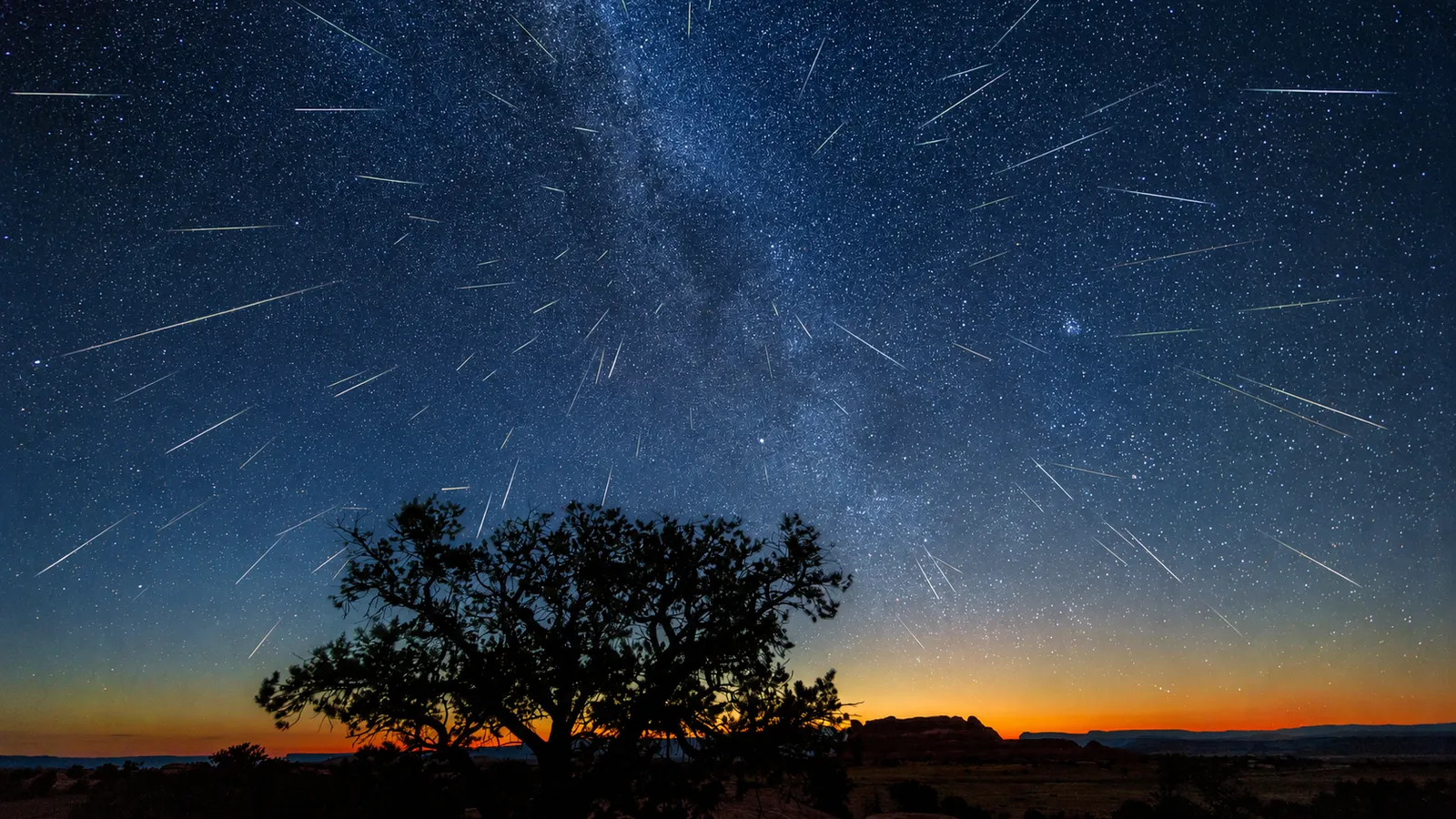
Table of Contents
The Perseids come back every August, but 2026 is a genuinely good year to make the effort. The peak overnight on August 12–13 lands on a new moon, which means no moonlight washing out the fainter meteors — the darkest conditions for this shower since 2018. Under a real national park sky, the strongest hours can deliver dozens of meteors, some of them bright, slow fireballs that leave a trail.
Where you go, what the weather does, and whether wildfire smoke drifts in will decide whether your night is unforgettable or a wash. Here's where to watch, when to show up, and how to photograph it — including the exact Nikon Z6II workflow I use, and the one lucky frame it got me.
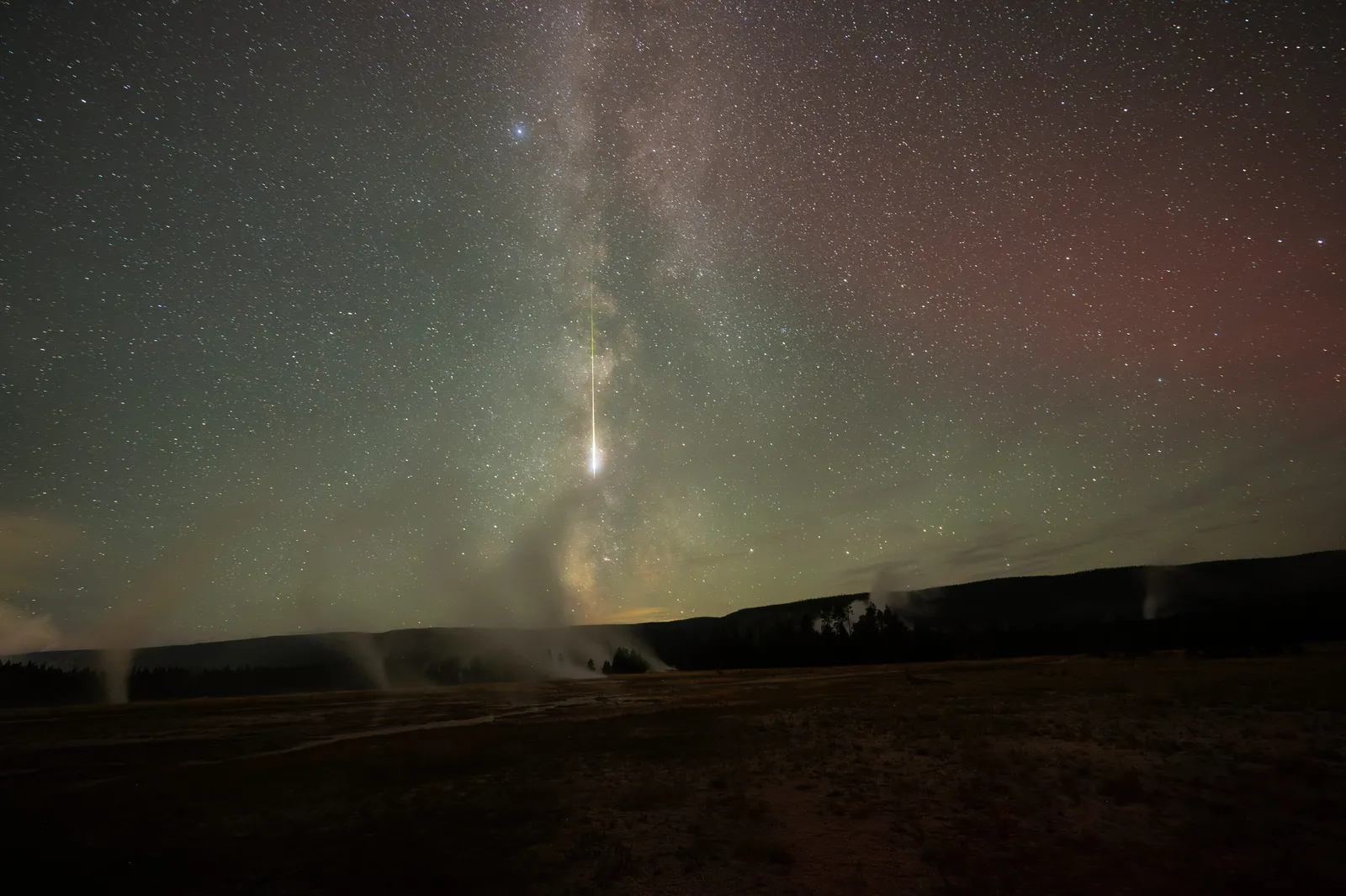
Yellowstone during the Perseids — a meteor cutting straight through the Milky Way over a geyser basin. Nikon Z6II, 14mm, one frame out of a few hundred. More on how this happened below.
📋 Use TrailVerse to check your park's live info — dark-sky ratings, alerts, hours, and current fire and smoke conditions are on each park's page. This guide covers the strategy.
The 60-second answer
The 2026 Perseids peak overnight from Wednesday, August 12 into Thursday, August 13, with the strongest activity in the pre-dawn hours of the 13th. The new moon means the whole night stays dark — the moon sets before 9pm and doesn't rise again until after sunrise. Find a dark location with a wide-open view of the sky, get comfortable, and watch from late evening through the hours before dawn. The later you stay up, the more you'll see.
Quick planning table
Question | Answer |
|---|---|
Peak night | August 12–13, 2026 (best in pre-dawn Aug 13) |
Best window | 2 a.m. to dawn |
Where to look | Broadly across the whole sky, not just at Perseus |
Telescope or binoculars? | No — your eyes are the right tool |
Moon | New moon — zero interference, best in years |
Realistic rate | 50–75/hour under a dark park sky; fewer if smoke or haze |
Dark adaptation | Allow 20–30 minutes |
Main threats | Clouds, wildfire smoke, artificial light, headlights |
The American Meteor Society lists the shower active from July 17 to August 24, with rates climbing steadily toward the mid-August peak. The Perseids' theoretical Zenithal Hourly Rate is about 100 — but that's a ceiling that assumes a perfect sky with the radiant directly overhead. In the real world, even a great dark-sky park delivers more like 50–75 an hour at peak, and that's still a spectacular night. NASA regularly calls the Perseids the best meteor shower of the year, and 2026's new-moon timing gives it a real shot at earning the title.
One curiosity worth knowing: the reason the moon is new that night is that a total solar eclipse happens the same day, August 12 — though its path runs over Greenland, Iceland, and Spain, so North America sees nothing of it. It doesn't affect your meteor night one way or the other, but it's why the timing lined up so well.
The best national parks for the 2026 Perseids
Ranking ten parks one through ten wouldn't help you plan — a remote Nevada Bortle 1 sky and an easy alpine road above Denver solve completely different problems. So these are grouped by what you're actually optimizing for: raw darkness, a great photo, an easy first trip, or staying close if you're on the East Coast. Pick one that fits your travel radius and your goal for the night; don't try to chase several.
Best for raw darkness
Great Basin National Park, Nevada. This is a Bortle Class 1 sky — as dark as it gets in the lower 48, and consistently ranked the darkest national park in the country. Head up toward Wheeler Peak or Mather Overlook for a wide-open view with essentially zero light pollution in any direction; the park sits in one of the least-populated corners of the country, so there's no city glow to fight. The tradeoff is remoteness — the nearest town, Baker, has limited food and gas, so fuel up and pack dinner before you drive in. Mountain nights turn cold fast even in August. Arrive well before sunset to scout and park while you can still see.
Big Bend National Park, Texas. Big Bend holds Gold Tier Dark Sky certification and sits inside the enormous Greater Big Bend International Dark Sky Reserve. Sotol Vista, the Santa Elena Canyon Overlook, and the Chisos Basin all give you wide, unobstructed sky, and Rio Grande Village adds river reflections as a bonus. The concerns are heat and distance: August days are brutal, and the entrances are hours from the nearest airport. Drive in during daylight, hydrate hard, and watch for isolated summer thunderstorms that build fast.
Capitol Reef National Park, Utah. A Gold Tier Dark Sky Park with far fewer visitors than its Utah neighbors. Panorama Point and the Fruita-area overlooks are easy short-walk viewpoints; for the darkest sky in the park, the Cathedral Valley backcountry delivers, though that road needs real planning and high-clearance. Late-night services inside the park are minimal, so gas up and eat in Torrey — itself Utah's first certified Dark Sky Community — before heading in.
Best for photography
Bryce Canyon National Park, Utah. Bryce has run astronomy programs for more than 50 years — among the longest-standing in the Park Service — and earned Gold Tier Dark Sky certification in 2019. On a moonless night you can see thousands of stars with the Milky Way arching over the hoodoos, which are one of the best natural foregrounds anywhere in the park system. The catch: Bryce draws crowds even on a random August night, and its 8,000-plus-foot elevation means genuinely cold after dark. Claim a viewpoint like Inspiration or Sunset Point early, and bring a real jacket even if you hiked in a t-shirt.
Great Sand Dunes National Park, Colorado. Bortle Class 2, with the dunes themselves making a foreground you can't get anywhere else — smooth, sweeping curves under a meteor-streaked sky. Wind is the main variable; it kicks up fast on the dunes and can make a long exposure miserable, and cold high-desert sand at night surprises people every year. Bring a red-mode headlamp, since the park actively discourages white light after dark.
Glacier National Park, Montana. A fully certified International Dark Sky Park, with summer star parties at Logan Pass that pull hundreds of visitors a night. Alpine lakes like Lake McDonald give you still-water reflections when the wind cooperates, putting mountains and glaciers under your meteors. The August risk is wildfire smoke — Glacier has seen significant fire activity in past Augusts, and smoke can wash out a perfect dark sky with almost no warning. Check current conditions before committing to a viewpoint, and see our Glacier 2026 guide for the shuttle and access details.
Easiest for first-timers
Joshua Tree National Park, California. A certified Dark Sky Park with four designated stargazing lots — Quail Springs, Hidden Valley, Cap Rock, and Ryan Mountain — so you don't have to guess where to set up. Pinto Basin, further east, has the darkest sky in the park. The issue is heat: August afternoons are extreme, so arrive in the early evening rather than midday and bring more water than you think you need.
Rocky Mountain National Park, Colorado. Trail Ridge Road, the highest paved through-road in the country, puts you above treeline with clear sky and no hiking required — the easiest car-access dark sky on this list. Bear Lake is a gentler option with a short walk and a shot at still-water reflections. Weather changes fast at elevation and overnight parking on Trail Ridge is limited, so arrive early with a backup pullout in mind. Note that Rocky Mountain still runs timed entry in 2026 — check our reservations guide before you go, though the 9am–2pm window won't affect a night arrival.
Acadia National Park, Maine. Some of the darkest skies left on the East Coast, which makes it the obvious pick if you're not driving west. Cadillac Mountain has the best overall view but takes effort (and a summit-road reservation in season); the Schoodic Peninsula is quieter and more remote; Sand Beach and the Seawall Picnic Area are easy, open-sky options. Coastal fog is the real threat here, so watch the marine forecast in the days before, not just a general weather app. Our Acadia 2026 guide covers the logistics.
Best East Coast option
Acadia, above, is the clear answer if you want a genuinely dark, certified-quality sky within driving distance of the Eastern Seaboard. If Acadia's too far, the takeaway that matters more than any single park applies double out east: drive to the darkest spot you reasonably can, because light pollution hurts meteor counts more than almost anything else.
Best time to watch
Evening gives you fewer meteors, but this is when you occasionally catch a long, dramatic earth-grazer that skims the atmosphere at a shallow angle and burns for a second or two across the whole sky. After midnight, rates climb steadily as your side of the planet rotates to face directly into the meteor stream. Pre-dawn is the payoff window — the radiant in Perseus sits highest, and NASA's guidance never changes: the last few hours before dawn are when the Perseids perform best. If you can only stay up for one stretch, make it 2 a.m. to dawn on August 13.
Can you see the Perseids from a city?
Yes — just fewer of them. Light pollution is the single biggest factor in how many meteors you'll catch, more than the specific park you pick. From a bright suburb you'll still see maybe 15–25 an hour at peak, and even a city park or a dark backyard will show the brightest fireballs punching through the glow. The improvement curve is steep, too: driving even 30–45 minutes out of a metro light dome to a darker county park or rural pullout can noticeably raise your count without a full expedition. If you can't get to one of the ten parks above, get to the darkest spot you reasonably can — that matters more than which patch of dark sky it is.
One scope note: the Perseids are a Northern Hemisphere shower. The radiant sits high for viewers across the US, Canada, Europe, and northern Asia, but from the Southern Hemisphere it barely clears the horizon, so meteor counts there are low. This is a northern-summer event.
How to watch without a camera
You don't need any gear to have a great Perseid night, and most first-timers over-prepare on equipment and under-prepare on patience. The meteors reward whoever stays out longest, not whoever spent the most.
Leave the telescope home. Meteors move too fast for one — your eyes are the right tool.
Find the widest possible sky. An open field or ridge beats a canyon or tree-lined trail.
Lie back and take in the whole sky instead of staring at Perseus. Meteors streak everywhere.
Kill your phone screen and flashlight. A few seconds of white light resets your night vision.
Use a dim red light only when you need it — for finding gear or reading a map.
Give your eyes 20–30 minutes to adapt before you judge how dark the sky really is.
Stay at least an hour. Rates come in waves; five minutes tells you nothing.
Park away from headlights, or agree as a group to kill lights together.
Bring real layers. Desert and alpine parks both drop 30-plus degrees after sunset, even in August.
Photography settings that actually work
There's no single correct exposure for meteors — your lens's widest aperture, your focal length, how bright your foreground is, and how dark your sky actually is all pull the numbers around. Start here and adjust from what you see on the back of the camera, not from a formula.
Starting point for a wide-angle setup:
Manual mode, always
A wide lens — 14–24mm gets more sky in frame and a better chance of catching a meteor
Aperture wide open — f/1.8 to f/2.8, whatever your lens allows
ISO 3200–6400 to start
10–20 second exposures, depending on focal length
Manual focus, locked on a bright star with live-view zoom
Continuous interval shooting, not single frames
RAW only
Long-exposure noise reduction OFF during the sequence — it doubles each exposure and you'll miss meteors while the camera processes
My Nikon Z6II setup for meteor nights
I shoot the Perseids on a Nikon Z6II, and this is the actual workflow, not a generic checklist.
I set the camera to full manual, open the lens to its widest aperture, and lock focus manually by zooming into a bright star in live view — autofocus hunts in the dark and will quietly ruin a whole sequence if you trust it. I run the built-in interval timer (Photo Shooting menu → Interval timer shooting) with a one-second gap between frames, no end time, going continuously until the card fills or the battery dies. I use the silent electronic shutter so I'm not wearing out the mechanical one over hundreds of frames a night. Two to three charged batteries is the real number for late-evening-to-dawn, since cold drains them fast — I keep spares in an inside jacket pocket, against my body, not in the bag.
For glass, I shoot my NIKKOR Z 14-24mm f/2.8 S wide open at 14mm for the biggest slice of sky, and switch to a fast 85mm f/1.8 only if I want to isolate a foreground or go after a deep-sky target between meteors. A full night usually gives me 400–600 frames; then I pull the keepers — the ones that actually caught a meteor — and stack them in Photoshop with the lighten blend mode, which combines several separate streaks over one static sky into a single composite.
One thing that ruins more meteor sequences than anything else: dew. On a clear, humid night your front element fogs over an hour or two in, and every frame after that is soft and hazy — usually without you noticing until you get home. A stick-on lens dew heater strip run off a small USB battery prevents it entirely, and it's the cheapest insurance in your bag. Check your lens every so often through the night if you don't have one.
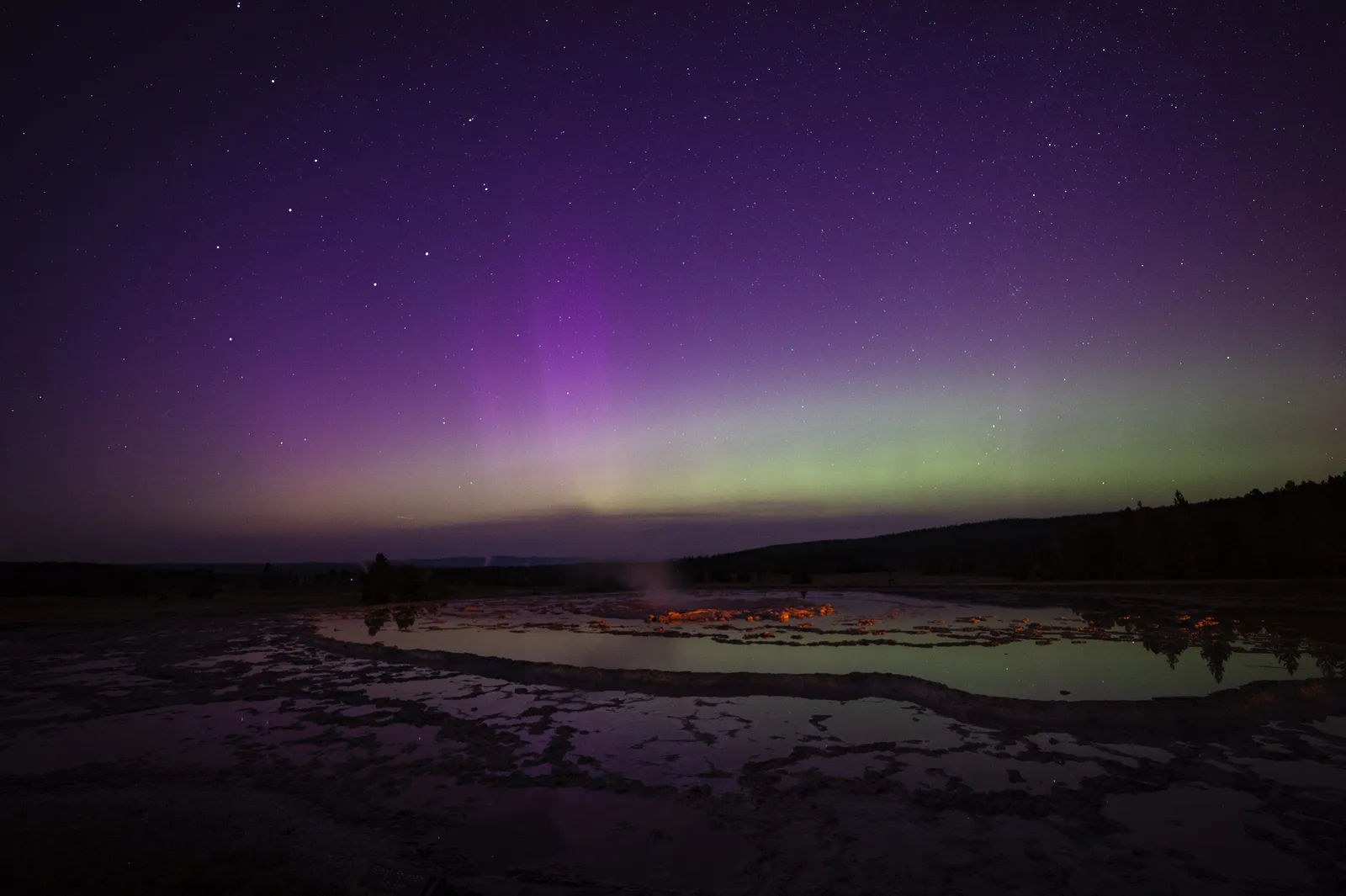
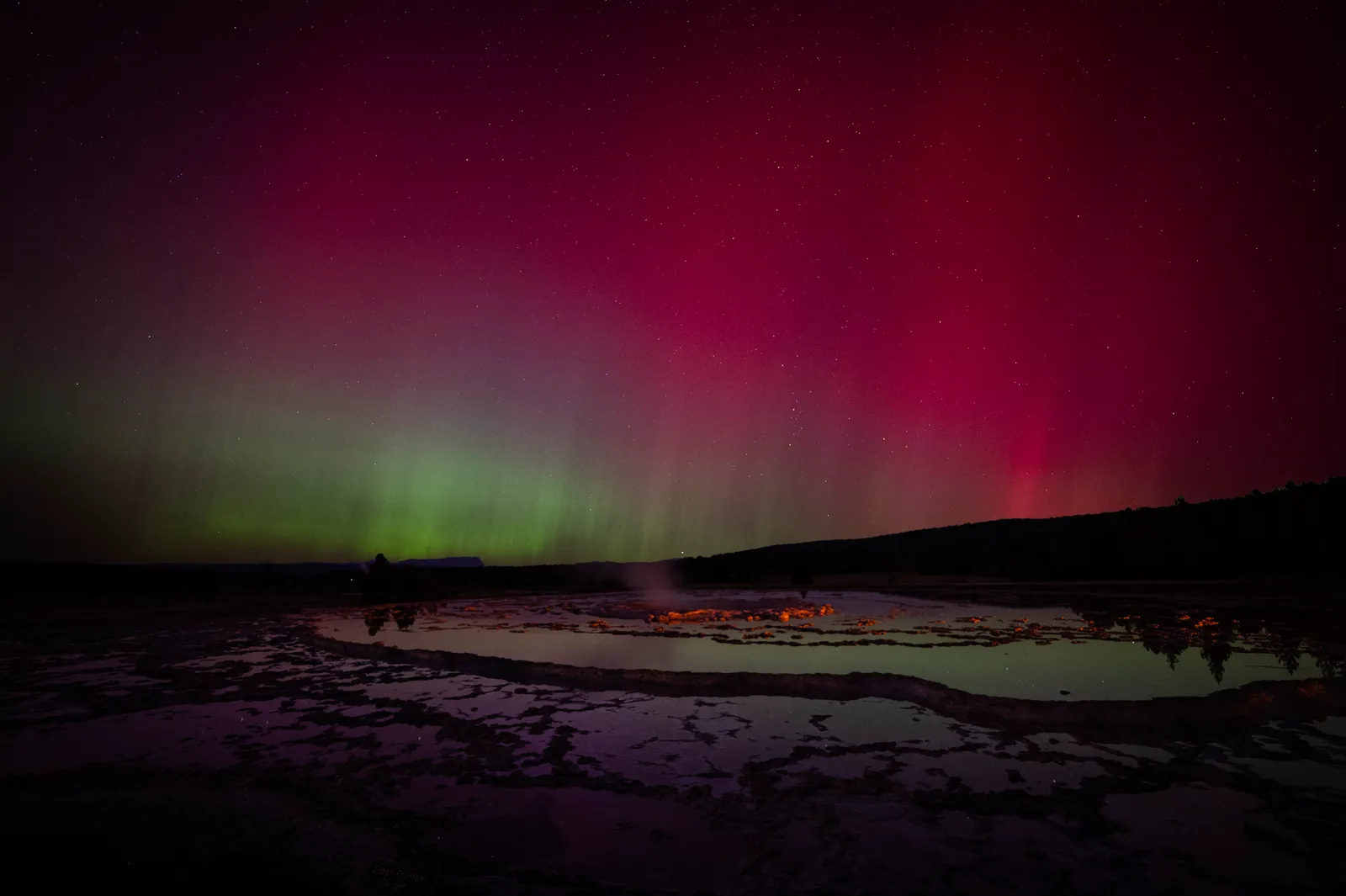
The best frame I ever got this way was mostly luck. I was in Yellowstone during the Perseids on a clear night that turned into a surprise aurora display, and I'd aimed the Z6II north hoping for the aurora when a bright meteor cut straight down through the Milky Way over a steaming geyser basin — the right direction at the right second, not something I planned. Yellowstone isn't on the ten-park list above because it isn't optimized for Perseid viewing the way a dedicated dark-sky desert park is, but if you're already headed there this August, the principle holds: point wide, shoot continuously, and let the sky do the work.
The same Yellowstone night — a surprise aurora over the geyser basin. When you're out shooting meteors, keep an eye on the whole sky; you never know what else shows up.
Later the same night, the aurora shifted to deep red and green. All of these came out of one session of pointing wide and shooting continuously.
Gear for a Perseid night
Split by what you're actually doing — most people need the first list, and only shooters need the second.
To watch (this is most people):
Reclining camp chair or padded ground pad — the single biggest comfort upgrade for meteor watching. You're looking straight up for hours; a chair that leans flat or a pad to lie back on is the difference between staying out till the pre-dawn peak and giving up with a sore neck at midnight.
Petzl Tikka CORE headlamp — red mode preserves your night vision and everyone else's; the white mode gets you to and from the car over uneven ground. Rechargeable via USB, so no scrambling for batteries.
Packable fleece or insulated layer — desert and alpine parks both drop 30-plus degrees after sunset, even in August, and you'll feel it most sitting still for hours. Pack more warmth than the daytime forecast suggests.
To shoot (add these to the camera you already have):
Manfrotto Befree Advanced tripod — a meteor sequence is hundreds of identical-framing long exposures, so a stable, locked tripod is non-negotiable. The Befree packs small for the hike to a viewpoint but extends to full height with a solid ball head.
Nikon EN-EL15c batteries (2-pack) — cold nights drain batteries fast, and a full late-evening-to-dawn shoot needs two or three. The EN-EL15c is the Z6II's native cell and holds charge in cold better than clones. Keep spares in an inside pocket against your body.
Lens dew heater strip — the one genuinely meteor-specific item here. On a clear humid night your lens fogs with dew and quietly ruins every frame after; a stick-on USB heater strip prevents it entirely for a few dollars. Cheap insurance against coming home with a soft, hazy sequence.
A note on the intervalometer: the Z6II has a built-in interval timer (Photo Shooting menu → Interval timer shooting), so you don't strictly need an external remote for meteor sequences — the in-camera timer does the job. A wired or wireless remote is still handy if you also want bulb exposures or vibration-free single frames.
Smoke and weather backup plan
A technically perfect dark-sky park is worthless if it's clouded over or full of smoke. This is the step people skip, and it's why so many meteor trips end in disappointment despite a great park choice. Build the backup before you leave home, not once you're already standing under clouds.
Check the hourly cloud forecast for your exact viewing spot, not just the nearest city.
Check air quality separately at AirNow.gov — a clear forecast can still hide wildfire smoke.
Review current NPS alerts for your park before driving in.
Look at park webcams where available to confirm live sky conditions.
Pick two backup locations within a reasonable drive of your first choice.
Confirm whether any gates or roads lock overnight — some parks close entrance gates after dark.
Don't commit to a hard backcountry hike on a five-day forecast; conditions change.
Common mistakes to avoid
Showing up right at "peak time" with no scouting done in daylight
Pointing the camera only at Perseus instead of a wide swath of sky
Bringing a telephoto instead of something wide
Checking your phone every few minutes and killing your night vision
Expecting a flat 100 meteors an hour regardless of where or when you watch
Standing near a road or lot where headlights sweep through
Skipping cold-weather layers because "it's the desert in August"
Giving up and leaving after fifteen minutes
Mistaking a satellite or plane for a meteor — meteors are fast and burn out in an instant; satellites crawl steadily
Ignoring wildfire smoke because the sky "looks fine" from your driveway
Plan your Perseid night with Trailie
Tell Trailie your starting city, how far you'll drive, whether you want photography or casual viewing, camping or a hotel, and your tolerance for heat, cold, or a long haul. It'll build you a recommended park, a sunset-to-dawn viewing schedule, a specific photography spot, a packing list, a backup location if the weather turns, and current alerts for wherever you land.
You've got about two weeks before the peak — enough time to pick a park, lock down lodging or a campsite, scout your spot, and watch the forecast as August 12 gets closer.
Verified July 2026. Weather, wildfire smoke, and seasonal closures change fast — check the Alerts tab on your park's TrailVerse page before you travel.
Keep reading
More on this topic from TrailVerse