Table of Contents
Yellowstone's Lamar Valley sits in Bortle Class 1 — the darkest classification on the scale, and skies as dark as anywhere in the contiguous United States. At Bortle 1, the Milky Way isn't a faint band of light. It casts visible shadows on the ground. The zodiacal light is bright enough to mistake for a city on the horizon. At Lamar Valley on a moonless July night, you may not need a headlamp to walk; the galaxy provides ambient light.
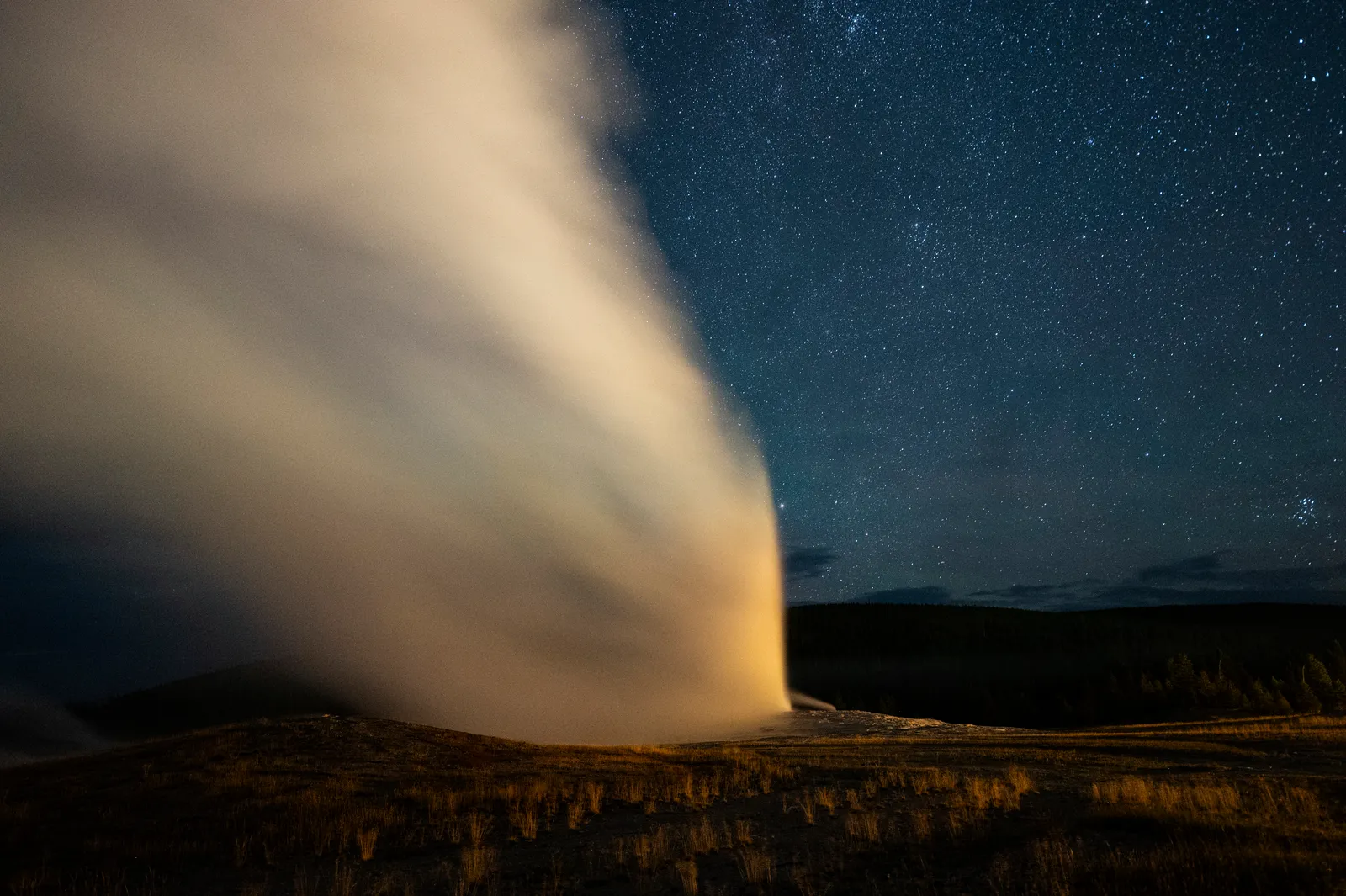
Beyond raw darkness, Yellowstone offers a compositional category found nowhere else on Earth: geothermal features under the night sky. Steam rising from Grand Prismatic Spring in long-exposure frames. Geyser plumes dissolving into the galactic core. The sulfur-edged silence of a hot spring basin at 2am. These are photographs you simply cannot make in any other national park.
📋 For trail conditions, wildlife, crowd strategy, and trip logistics, see the Yellowstone Complete Guide. This article is entirely about the night sky.
Dark Sky Data
Yellowstone is one of the most genuinely dark national parks in the lower 48. The northeast sections — particularly Lamar Valley — reach Bortle Class 1, the maximum possible darkness on the classification scale. Central park areas (Hayden Valley, Grand Canyon of the Yellowstone) sit at Bortle 2. Developed areas near Old Faithful, Canyon Village, and Mammoth Hot Springs rate at Bortle 3.
Bortle Class: 1 at Lamar Valley and remote northeast; 2 at Hayden Valley and central park; 3 near Old Faithful/Canyon Village
Sky Quality: ~22.0–22.5 mag/arcsec² at Lamar Valley (Bortle 1 range); ~21.5–22.0 at Hayden Valley
DarkSky Certification: Not yet certified — IDA International Dark Sky Park certification in progress
Darkest Site: Lamar Valley (northeast), remote Yellowstone Lake shoreline, Hayden Valley center
Light Pollution Direction: Jackson/Teton area ~60 miles south; Cody, WY ~50 miles east; Livingston/Bozeman, MT ~50+ miles north. All domes are distant and sit at very low altitude. Lamar Valley delivers clean sky in every shooting direction.
At Bortle 1, the Milky Way has three-dimensional structure. You see not just a band of light but a textured system — distinct star clouds, dark dust lanes weaving between them, glowing nebula regions visible to the naked eye. Dozens of Messier objects are visible without optical aid. Lamar Valley's wide, open terrain means you see all of this horizon to horizon, with the sky dome arching unobstructed from one ridge line to the other.
Milky Way Visibility Calendar
Yellowstone sits at approximately 44.5°N — higher latitude than both Yosemite and Grand Teton. The galactic core rises in the southeast, transits due south at a peak altitude of approximately 20–22° above the horizon, and sets in the southwest. That lower peak altitude compared to southern parks means the core arcs more horizontally across the southern sky — it's elongated and sweeping in a way that works especially well in Lamar Valley's wide, flat terrain. A clear southern horizon is important; at 44.5°N the core doesn't get much altitude to spare.
The park has no access restrictions tied to sky shooting. All major roads are open by late May — the Northeast Entrance Road (Lamar Valley) is one of the few routes accessible year-round, including winter.
Month | Core Visible | Hours/Night | Best Window | Notes |
|---|---|---|---|---|
January | No | 0 | — | Core below horizon; Northeast Entrance open but winter conditions |
February | No | 0 | — | Core below horizon |
March | Pre-dawn only | ~0.5 | 4:30–5am | Season barely opening |
April | Pre-dawn | ~1.5 | 3:30–5am | Cold, limited; Lamar Valley accessible |
May | Late night | 3–4 | 1–4am | South Entrance opens May 8; full Lamar access |
June | Most of night | 5–6 | 11pm–4am | New moon June 15 — prime window |
July | Most of night (peak) | 5–6 | 10pm–4am | Best month. New moon July 14. Target Lamar Valley. |
August | Evening–midnight | 5–6 | 9pm–2am | New moon Aug 12; check wildfire smoke conditions |
September | Early evening | 3–4 | 8:30–11:30pm | Elk rut foreground; fall color in valley |
October | Dusk only | ~1.5 | 8–9:30pm | Core setting fast; season winding down |
November | No | 0 | — | Core below horizon |
December | No | 0 | — | Core below horizon |
2026 new moon dates for peak months:
June 15, 2026 — Prime window: June 12–19. Lamar Valley fully accessible.
July 14, 2026 — Prime window: July 11–18. Best of the year. The target date for Lamar Valley Bortle 1.
August 12, 2026 — Solar eclipse new moon. Prime window: August 9–16. Check AirNow.gov before traveling — Western U.S. wildfire smoke can degrade Bortle 1 to Bortle 4 within hours, and Yellowstone is downwind of multiple fire zones in late summer.
Light pollution geometry from Lamar Valley: All shooting directions deliver clean sky. No dominant dome in any direction. For the purest frames, shooting north toward the Montana border gives the lightest background. The galactic core transits due south — a faint glow from Jackson/Teton is present low on the southern horizon on clear nights but sits well below the core's 20°+ transit altitude.
Best Shooting Locations
1. Lamar Valley (Northeast Entrance Road)
Lamar Valley is Yellowstone's premier astrophotography location. It's a remote section of the park — approximately 50 miles by road from the West Entrance via Mammoth Hot Springs and Tower Junction — and it sits at Bortle 1. The valley floor is wide and open: no trees to block low-altitude objects, rolling hills and the Lamar River providing foreground interest, and a sky dome that spans horizon to horizon without obstruction.
The practical advantage: you're shooting from your car door. Drive the Northeast Entrance Road east from Tower Junction toward Cooke City and you're in Lamar Valley in about 10 miles. Numerous paved pullouts line the road throughout the valley. No hiking required. At night the road is essentially deserted — it's not unusual to have miles of it to yourself on a weeknight.
Composition options from Lamar: the valley floor with rolling hills in the foreground under the Milky Way arch; the Lamar River as a leading line into the galactic core; the Buffalo Ranch historic structures (visible in silhouette); bison silhouettes on the valley floor when present. The full Milky Way arch is visible from one horizon to the other in July — a 14mm panoramic stitch captures the complete structure.
Getting there at night: Tower Junction to the start of the valley is about 10 miles east. The road is paved and remains open after dark. Drive slowly — bison cross at night with no warning. Bring warm layers regardless of month; Lamar Valley drops below 40°F on July nights regularly, and below 25°F in May and September. Cell service is essentially nonexistent throughout Lamar — download offline maps, check NPS road status, and confirm settings before driving in.
2. Hayden Valley (Central Park)
Hayden Valley sits in the center of the park's figure-eight road loop, a broad treeless valley straddling the Yellowstone River. Its open landscape — the same quality that makes it Yellowstone's best inland wildlife viewing area by day — makes it a natural nighttime shooting platform. Bortle 2 rating here puts it well above Yosemite Valley or Grand Teton's Jenny Lake. The Yellowstone River adds a reflective foreground element on still nights.
The Hayden Valley tradeoff versus Lamar: it's Bortle 2 instead of 1, but it's dramatically more accessible — Canyon Village is nearby, and the Grand Loop Road through the valley is one of the most-driven routes in the park. For visitors not making the full Lamar drive, Hayden Valley delivers genuinely excellent skies.
One specific note: Canyon Village to the north creates a very faint glow on the northern horizon from Hayden Valley. Shooting south or southwest gives the cleanest sky. Wildlife in the valley at night is active — bison frequently cross the road and can appear in your headlights without warning. Drive very slowly on the Grand Loop through here after dark.
Getting there at night: Multiple large pullouts on the Grand Loop Road between Fishing Bridge and Canyon Village. All paved, no hiking required. No time restrictions on pullout access.
3. Grand Prismatic Spring Overlook (Midway Geyser Basin)
This is the composition that exists nowhere else on Earth. Grand Prismatic Spring produces a continuous steam plume rising from the largest hot spring in the United States — in long-exposure frames at night, that steam becomes an ethereal white column under the galactic core. The thermophile mats ringing the spring — vivid orange, yellow, and green by day — retain color visible even in starlight. Boardwalk leading lines, rising steam, and the Milky Way overhead: it's a complete image in a way most locations aren't.
The steam behaves differently by season. In July (low ambient humidity, warmer nights), steam plumes are lighter — more transparent, allowing the spring's color and the sky behind it to register simultaneously in a single frame. In shoulder months (May, September), heavier steam can obscure the spring. July is the target.
Getting there at night: Park at the Fairy Falls trailhead on Fountain Flat Drive, just south of the main Midway Geyser Basin lot. The overlook trail is approximately 1.6 miles round trip. Use a red headlamp — the area has the thinnest geothermal crust in the park. Stay strictly on the marked trail and boardwalk at all times. At night in particular, going off-trail in a thermal area is extremely dangerous. The NPS requires trail access — no off-boardwalk shooting.
Bortle class here (near Old Faithful area) is approximately 3, lighter than Lamar or Hayden. You're not here for the darkest sky. You're here for the only foreground of its kind on the planet.
Nikon Z6II Settings
The Z6II handles Yellowstone's conditions well. At Bortle 1 in Lamar Valley, the sensor captures galactic core signal with ISO 1600–3200 — pushing higher risks clipping the brightest core regions. At Hayden Valley (Bortle 2), ISO 3200 remains optimal. For the Grand Prismatic steam shoot, a two-exposure workflow (sky + steam foreground separately) handles the scene's contrast range more effectively than a single frame.
500-rule shutter calculations (for NIKKOR Z 14-24mm f/2.8 S):
500 ÷ 14mm = 35 seconds max — use 20–25 seconds for sharper stars on the Z6II's high-resolution sensor
500 ÷ 20mm = 25 seconds
500 ÷ 24mm = 20 seconds
Scenario | ISO | Aperture | Shutter | White Balance | Lens |
|---|---|---|---|---|---|
Milky Way — Lamar (Bortle 1) | 1600–3200 | f/2.8 | 20–25s | 3800–4000K | NIKKOR Z 14-24mm f/2.8 S @ 14mm |
Milky Way — Hayden (Bortle 2) | 3200 | f/2.8 | 20–25s | 3800–4000K | NIKKOR Z 14-24mm f/2.8 S @ 14mm |
Grand Prismatic Steam + Sky | 1600–3200 | f/2.8 | 20–25s | 4200K (warmer for steam glow) | NIKKOR Z 14-24mm f/2.8 S |
Grand Prismatic foreground blend | 800 | f/4 | 60–120s | 4200K | NIKKOR Z 14-24mm f/2.8 S |
Star Trails (interval stack) | 800 | f/2.8 | 60s/frame | 3800K fixed | NIKKOR Z 14-24mm f/2.8 S |
Moon + Thermal Landscape | 400–800 | f/5.6 | 1–4s | 5500K | NIKKOR Z 24-70mm f/2.8 S |
Z6II-specific tips for Yellowstone:
Long Exposure NR: OFF. Disables the dark-frame delay between shots. Essential for maximizing frames per session. Without this off, you lose half your shooting time waiting.
IBIS/VR: OFF on tripod. Active stabilization creates micro-vibration on a stationary camera. Disable both in-body and lens VR when tripod-mounted.
Focus: manual with 10× live view. Point at the brightest star in frame, magnify to 10× in live view, manually adjust until the star collapses to its smallest point. Lock focus and don't adjust the ring.
Release: 2-second self-timer or remote shutter. Shutter button contact introduces vibration. Use the 2-second delay or a wired/wireless remote on a tripod shot.
Grand Prismatic steam blending. Shoot one sky frame at ISO 3200 / 25 seconds for the Milky Way, then a separate foreground/steam frame at ISO 800 during blue hour (post-sunset twilight, before full dark). The steam is more visible, and the spring's color shows more vividly during the 20-minute twilight window. Blend in Lightroom or Photoshop.
Bear country at night. Yellowstone has one of the highest densities of grizzly bears in the lower 48. At Lamar Valley night shoots: stay within 50 feet of your vehicle, carry bear spray on your hip (not in your bag), and do not wander into the valley darkness. Bison also move through shooting areas at night with no warning — use a red headlamp and watch your surroundings.
Cold management. Lamar Valley drops below 40°F even in July. The Z6II's battery performance degrades meaningfully in cold. Carry a spare in an inner pocket, swap when performance drops.
What to Photograph (Deep Sky Objects)
The galactic center in July: Due south, 20–22° above the horizon at Lamar Valley. The galactic core region in Sagittarius is the most impressive naked-eye Milky Way experience accessible in the lower 48. The Lagoon Nebula is resolvable by naked eye on a moonless July night; the Trifid and Eagle Nebulae are easily visible in binoculars. In a 30-second Z6II frame at ISO 3200, all three register as distinct pink-red clouds embedded in the bright core.
The full Milky Way arch: Lamar Valley's flat terrain gives you clear views from the southeastern horizon to the northwestern one. In July, the complete arch — from the bright galactic core rising in the SE to the fainter outer-disk regions setting in the NW — spans the entire sky. A 14mm portrait-orientation panoramic stitch captures the complete structure. No other park combines this degree of darkness with this degree of flat, unobstructed sky access.
The Andromeda Galaxy: Rises in the northeast in August–September. In Lamar Valley, Andromeda is easily naked-eye — not just a point of light but a visible elongated form with a gradient from bright core to fading halo. In 10×50 binoculars it fills the field. Its two satellite dwarf galaxies (M32 and M110) are visible in binoculars. By late September in Lamar Valley, you can frame Andromeda above the northeast ridge line with the Milky Way still arcing south — two galaxies in the same sky.
Geothermal features with star points: Old Faithful erupts on average approximately every 90 minutes throughout the night (predicted intervals posted at the visitor center). The geyser plume at night — lit from below by the surrounding basin glow, steam catching starlight — is worth a dedicated shoot on its own. Build a time-lapse around a predicted eruption window.
NPS Ranger Programs & Astronomy Events
Yellowstone's main astronomy program is Stars Over Yellowstone — a partnership between the National Park Service, the Museum of the Rockies (Bozeman), and the Southwest Montana Astronomical Society that's been running since 1999. Programs are held at the Madison Amphitheater on select Friday and Saturday nights in June and July, with rangers and amateur astronomers providing telescopes for celestial viewing of constellations, planets, and deep-sky objects.
New for 2026, Yellowstone Forever is launching a Junior Ranger Night Sky Explorers program — the park's first dedicated youth astronomy curriculum. Check the NPS Ranger Programs page and the Yellowstone Forever stargazing programs page for current 2026 dates closer to your visit.
Gear for Astrophotography at This Park
At Bortle 1 with bear country, cold nights, and thermal area access requirements, Yellowstone demands more preparation than most parks:
Petzl Tikka CORE headlamp — required at every shooting location. White light destroys night vision for 20+ minutes, affects neighboring photographers, and should not be used in wildlife areas where you need to maintain situational awareness. The Tikka CORE's 450-lumen output handles the unpaved approaches at Lamar Valley and the dedicated red mode is one button press away. Rechargeable via USB.
Counter Assault Bear Spray (8.1 oz, 32ft range) (mandatory in Lamar Valley night shoots) — mandatory for Lamar Valley night shoots. Wear it on your hip, not in your bag — you need under-three-second access. The 8.1 oz canister with 2% capsaicin and 32-foot range is the standard Yellowstone-recommended formulation. TSA prohibits flying with bear spray; buy on Amazon for home delivery before your trip or pick up locally in West Yellowstone, Bozeman, or Jackson on arrival.
Manfrotto Befree Advanced tripod — Lamar Valley ground is uneven and valley wind can pick up unexpectedly. The Befree Advanced packs down to under 16 inches but extends to full height with a stable ball head — the lever-lock legs deploy faster than twist-locks when you're racing dusk. Hang your camera bag from the center column for extra stability in wind.
Nikon EN-EL15c batteries (2-pack) — cold nights at Lamar drain lithium batteries faster than you expect. A Z6II battery can die in 90 minutes when temps drop below 40°F. The EN-EL15c is the Z6II's native battery — third-party clones often don't hold charge in cold. Keep the spare in an inside jacket pocket against your body.
JJC wireless intervalometer remote — pressing the shutter button directly transmits vibration that smears stars in 25-second exposures. The JJC is Z6II-compatible and adds programmable intervals for star trails (200–400 frame sequences without standing at the camera) and built-in time-lapse mode for Grand Prismatic steam sequences.
PhotoPills — iOS/Android app for planning the exact Milky Way arc over Lamar Valley's terrain using AR mode. Essential for pre-visualizing composition before you drive 50 miles to get there. Pair with the free Stellarium app for nebula identification.
Frequently Asked Questions
What is Yellowstone's Bortle class?
Lamar Valley and the remote northeast sections of Yellowstone reach Bortle Class 1 — the darkest possible classification, and skies as dark as anywhere in the contiguous U.S. Hayden Valley rates Bortle 2. Areas near Old Faithful and Canyon Village are Bortle 3. For astrophotography, Lamar Valley is the target.
Is Yellowstone a certified Dark Sky Park?
Not yet. Yellowstone is actively working toward IDA International Dark Sky Park designation but does not currently hold certification. Lamar Valley's Bortle 1 rating makes it one of the darkest accessible locations in the lower 48 regardless of certification status.
What is the best month for Milky Way photography at Yellowstone?
July is the best month — the galactic core is visible for 5–6 hours per night, all roads are open, and the July 14 new moon in 2026 gives a prime shooting window from July 11–18. The park's full road network is accessible and temperatures are warmest (still cold by midnight in Lamar Valley).
What Nikon Z6II settings should I use at Yellowstone?
At Lamar Valley (Bortle 1): ISO 1600–3200, f/2.8, 20–25 seconds, 3800–4000K with the NIKKOR Z 14-24mm f/2.8 S at 14mm. At Hayden Valley (Bortle 2): ISO 3200. For Grand Prismatic Spring shoots, use 4200K white balance for warmer steam tones, and plan a two-exposure blend (sky + foreground during blue hour at ISO 800). Long Exposure NR off, IBIS off on tripod.
What's the best location for Milky Way photography in Yellowstone?
Lamar Valley for the darkest sky and the most unobstructed horizon-to-horizon sky access — it's Bortle 1 and requires no hiking. Hayden Valley for Bortle 2 with the Yellowstone River as reflective foreground. Grand Prismatic Spring Overlook for the geothermal steam + Milky Way composition that exists nowhere else on Earth.
Is it safe to shoot astrophotography alone at night in Yellowstone?
Lamar Valley and Hayden Valley have high grizzly bear activity. Shooting alone at night from your car is reasonable — stay within 50 feet of your vehicle, carry bear spray accessible on your hip, and use a red headlamp. Don't wander into the open valley in full darkness. In thermal areas (Grand Prismatic), stay strictly on designated trails and boardwalks — the crust around geothermal features is dangerously thin, especially at night when visual assessment is difficult.
🗺️ Planning your trip? TrailVerse's AI trip planner builds custom itineraries based on your dates, interests, and pace.
➡️ Pairing it with Grand Teton? Use the Compare National Parks tool, then send your choice into the AI Trip Planner to build a 5–7 day Wyoming itinerary.
Keep reading
More on this topic from TrailVerse