Table of Contents
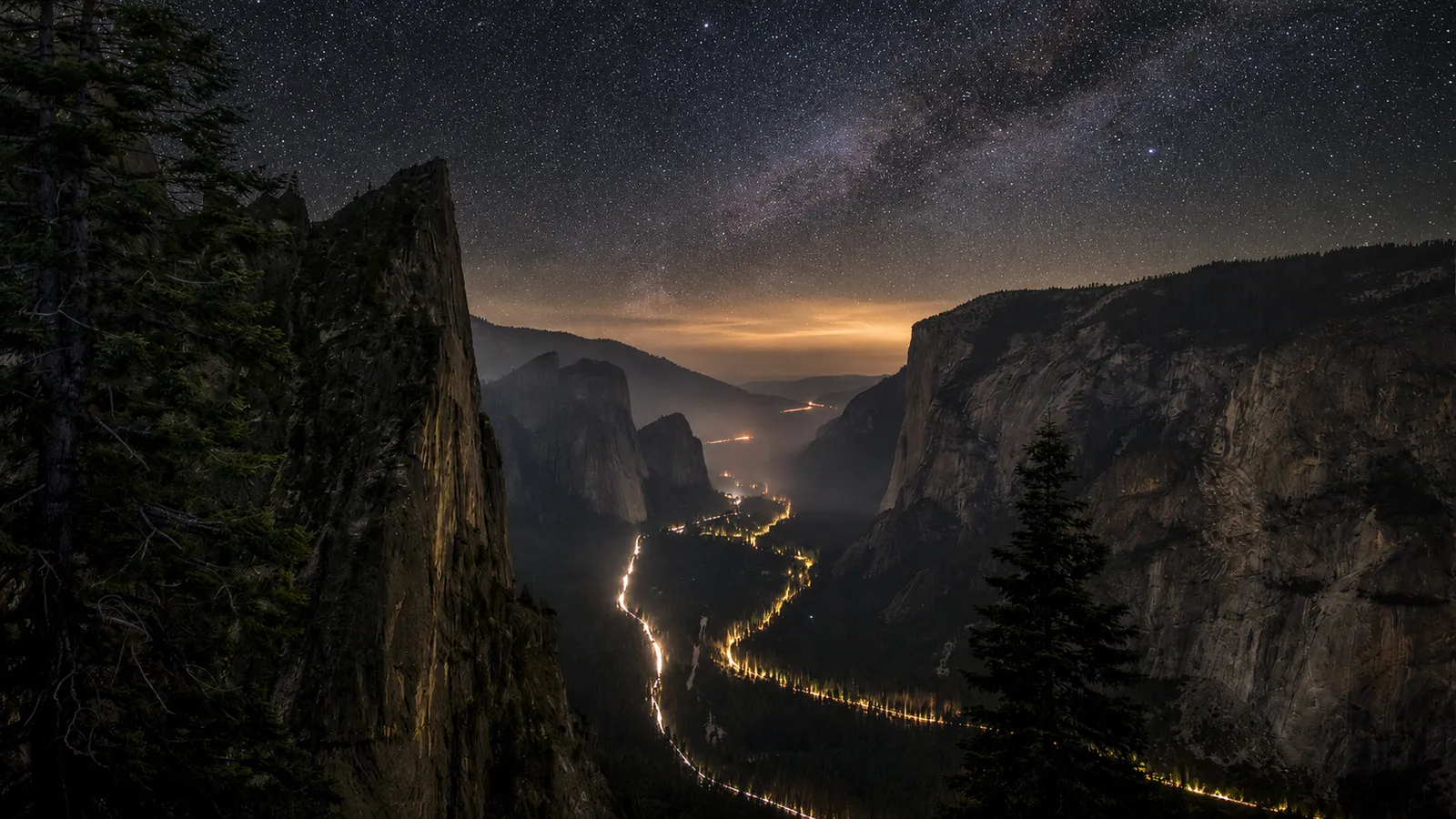
Yosemite delivers astrophotography compositions that don't exist anywhere else — El Capitan's 3,000-foot granite wall under the Milky Way, Half Dome rising from the Valley floor into the galactic core, the Cathedral Peaks of Tuolumne Meadows silhouetted against a structured sky.
The high country reaches Bortle Class 3 — legitimately dark, with the Milky Way showing distinct structure and Andromeda visible to the naked eye. The Valley floor sits at Bortle 4–5, dimmer but still delivers those one-of-a-kind granite foregrounds.
The whole game at Yosemite is matching the right location to the shot you want. Dark sky or iconic foreground — sometimes both — but rarely in the same frame.
📋 For trail info, crowd strategy, Half Dome permits, and trip logistics, see the Yosemite Complete Guide. This article is purely about the night sky.
Dark Sky Data
Yosemite's high country holds Bortle Class 3 ratings at Tuolumne Meadows and Glacier Point. The park's average Sky Quality Meter reading is approximately 21.0–21.5 mag/arcsec² at Tuolumne Meadows and 20.5–21.0 at Glacier Point. Yosemite Valley sits at Bortle Class 4–5 due to the Fresno light dome to the southwest.
Bortle Class: 3 at Tuolumne Meadows (8,600 ft) and Glacier Point; 4–5 at Yosemite Valley floor
Sky Quality: ~21.0–21.5 mag/arcsec² (Tuolumne); ~20.5–21.0 (Glacier Point); ~20.0 (Valley)
DarkSky Certification: Not certified — no IDA application on record
Darkest Site: Tuolumne Meadows and the Tioga Road corridor
Light Pollution: Fresno, CA (~60 miles SW) creates the dominant dome; San Jose/Bay Area (~100 miles WNW) is secondary. Shoot north, northeast, or east for cleanest sky.
At Bortle 3 in Tuolumne Meadows, the Milky Way is clearly structured — dark dust lanes visible with the naked eye, brighter star-cloud regions distinct from each other. Andromeda is an obvious naked-eye oval, not a point. At 8,600 feet, thinner and drier air gives a crispness to stars that sea-level Bortle 3 sites don't match. Even at Bortle 4 in the Valley, El Capitan and Half Dome as foreground under any visible sky makes the shot worth making — these are subjects with no equivalent anywhere else.
Milky Way Visibility Calendar
Yosemite sits at approximately 37.8°N latitude — lower than Yellowstone and Grand Teton, which means the galactic core rises higher in the southern sky. Peak altitude is around 28–30° above the horizon, compared to 20–22° at Yellowstone. That extra altitude matters: more sky between the core and the Fresno horizon dome, less atmospheric haze affecting the lowest core frame, and more of the galactic arch visible overhead rather than low.
2026 update: Tioga Road opened May 15, 2026 at 8am — the earliest start in 11 years thanks to a record-low snowpack. Tuolumne Meadows is accessible for the entire 2026 Milky Way season, including the June 15 new moon.
Month | Core Visible | Hours/Night | Best Window | Notes |
|---|---|---|---|---|
January | No | 0 | — | Core below horizon |
February | No | 0 | — | Core below horizon |
March | Pre-dawn only | ~1 | 4–5am | Tioga/Glacier Point roads closed |
April | Pre-dawn | ~2 | 3–5am | Valley accessible; high country closed |
May | Late night | 3–4 | 1–4am | Tioga opened May 15, 2026 — Tuolumne accessible second half of month |
June | Most of night | 5–6 | 11pm–4am | New moon June 15 — first prime Tuolumne window |
July | Most of night (peak) | 5–6 | 10pm–4am | Best month. New moon July 14. |
August | Evening–midnight | 5–6 | 9pm–2am | New moon Aug 12; check wildfire smoke conditions |
September | Early evening | 3–4 | 8:30–11:30pm | Lower core; autumn foreground possibilities |
October | Dusk only | ~1.5 | 8–9:30pm | Tioga/Glacier Point roads close late month |
November | No | 0 | — | Core below horizon |
December | No | 0 | — | Core below horizon |
2026 new moon dates for peak months:
June 15, 2026 — Prime window: June 12–19. First full Tuolumne window of the season.
July 14, 2026 — Prime window: July 11–18. Best of the year. Target date for Tuolumne Meadows / Lembert Dome.
August 12, 2026 — Prime window: August 9–16. Solar eclipse new moon. Check AirNow.gov before traveling — California wildfire smoke can drop Bortle 3 conditions to Bortle 5 within hours, and afternoon wind shifts can change conditions overnight.
Light pollution geometry: Shoot north, northeast, or east from Tuolumne for the cleanest sky. The core arcs through due south — the Fresno dome sits low but present on the SW horizon. From Glacier Point, the Valley floor contributes minor ambient glow below; best shooting eastward toward Half Dome. From the Valley, the walls themselves limit your horizon — work with that constraint by composing upward.
Best Shooting Locations
1. Tuolumne Meadows (Tioga Road, ~8,600 ft)
Tuolumne Meadows is Yosemite's best dark sky location — Bortle 3, 8,600 feet, open glacier-carved terrain with a wide sky from horizon to horizon. Lembert Dome provides a clean granite foreground without blocking the horizon. Tenaya Lake a few miles west adds reflective foreground when the surface is calm — on a still July night the lake mirrors the galactic core directly. The Cathedral Peaks on the south side of the meadow give you an alpine skyline that no Valley location can match.
The Tuolumne Meadows parking area stays open after dark. No hiking required for meadow foreground; a five-minute walk puts you in position with Lembert Dome in frame. Bring serious layers — temperatures drop below 35°F on July nights at 8,600 feet even in peak summer. Bears are active in Tuolumne at night; keep food secure in your car.
2. Glacier Point (~7,214 ft)
Glacier Point is Yosemite's most iconic astrophotography position — elevated 3,200 feet above the Valley floor, looking directly at Half Dome in the frame's foreground while the Milky Way arcs overhead. The NPS runs "Stars Over Yosemite" programs at the Glacier Point amphitheater most Fridays and Saturdays through summer (8:30pm), partnering with rotating amateur astronomy clubs that bring telescopes. The paved parking lot at the road's end means no hiking — it's a drive-and-shoot location accessible as soon as Glacier Point Road opens.
The main overlook wall faces Half Dome due east — a 14mm frame centers the dome in the lower right with the core sweeping left overhead. Weekend summer nights bring other photographers and some ambient headlamp activity. Insider alternative: the 0.7-mile walk to Sentinel Dome offers a quieter 360° view and is the move when Glacier Point itself feels too busy.
3. Tunnel View / El Capitan Meadow (Valley Floor, Bortle 4–5)
The Valley floor isn't where you go for the darkest sky — you go for the foreground. Tunnel View gives the iconic framed composition: El Capitan left, Half Dome center-right, Bridalveil Fall at the V between them, all in a single 14mm frame under the Milky Way. El Capitan Meadow (Northside Drive pullout) gives a direct face-on view of the 3,000-foot wall. Both are paved pullouts requiring no hiking.
The Valley's unique astrophotography opportunity is El Capitan with active climbing routes lit by headlamps. Climbers visible on portaledges during the May–October big-wall season create natural light elements in the dark granite face — though the timing window is narrow: climbers' headlamps are typically visible at dusk and again before dawn when they're settling in or getting moving, less so during the 11pm–3am Milky Way prime window. Shooting one sky exposure during prime hours and one longer foreground exposure (ISO 800, f/4, 4–8 seconds) at dusk when climbers are visible, then blending in post, creates a result specific to Yosemite that no other park can replicate.
Nikon Z6II Settings
The Z6II handles both the Bortle 3 high country and the more light-affected Valley well — the sensor's back-illuminated design captures faint signal cleanly and its dynamic range handles bright granite reflections in moonlight without blowing out. At Bortle 3 in Tuolumne, ISO 3200 is often all you need. In the Valley at Bortle 4–5, ISO 3200 at f/2.8 usually delivers enough signal.
500-rule shutter calculations:
500 ÷ 14mm = 35 seconds max — use 20–25 seconds for sharper stars
500 ÷ 20mm = 25 seconds
500 ÷ 24mm = 20 seconds
Scenario | ISO | Aperture | Shutter | White Balance | Lens |
|---|---|---|---|---|---|
Milky Way — Tuolumne (Bortle 3) | 3200 | f/2.8 | 20–25s | 3800–4000K | NIKKOR Z 14-24mm f/2.8 S @ 14mm |
Milky Way — Valley (Bortle 4–5) | 3200 | f/2.8 | 20–25s | 3800–4000K | NIKKOR Z 14-24mm f/2.8 S @ 14mm |
El Capitan foreground blend | 800–1600 | f/4 | 4–8s | 5500K | NIKKOR Z 14-24mm f/2.8 S |
Star Trails (interval stack) | 800 | f/2.8 | 60s/frame | 3800K fixed | NIKKOR Z 14-24mm f/2.8 S |
Moon + Valley / Half Dome | 400–800 | f/5.6 | 1–4s | 5500K | NIKKOR Z 24-70mm f/2.8 S |
Z6II-specific tips:
Long Exposure NR: OFF. The dark-frame delay after each shot halves your shooting time per night. Disable in the shooting menu.
IBIS/VR: OFF on tripod. Active stabilization creates micro-vibration on a stationary camera. Turn off both in-body and lens VR when tripod-mounted.
Focus: manual with 10× live view. Point at the brightest star in frame, zoom to 10× in live view, manually focus until the star collapses to its smallest point. Lock and don't touch the ring.
Release: 2-second self-timer or remote shutter. Shutter button contact introduces vibration on a tripod shot. Use the 2-second delay or a wired/wireless remote.
El Capitan foreground blending. For Valley shots, expose the sky at ISO 3200 / 25 seconds for the Milky Way, then expose the foreground separately at ISO 800 / 4–8 seconds during blue hour or with natural moonlight. Blend the two exposures in Lightroom or Photoshop.
NPS light painting policy. Yosemite prohibits artificial light painting on rock formations. Keep your lighting on your gear and your path only.
What to Photograph (Deep Sky Objects)
In July from Tuolumne Meadows, the galactic core region is the primary subject — at 28–30° altitude it's well clear of the Fresno horizon dome. The Sagittarius region shows real brightness and color variation in a 30-second frame at 14mm, and the Lagoon Nebula sits just above the Sagittarius Teapot asterism as a faint naked-eye smudge, resolving as a pink-red cloud in a processed Z6II frame at ISO 3200.
By late July, the Andromeda Galaxy is already well-positioned in the northeast and easily naked-eye from Tuolumne — a distinct elongated glow with a visible gradient from core to halo. September is particularly useful at Yosemite because some early autumn gold appears in the Valley meadows and along Tioga Road, giving you a warm-colored foreground under a darkening sky as the galactic core sets earlier. Two-exposure blends (golden hour foreground + late-night sky) work exceptionally well in September.
Ranger Programs & Astronomy Events
The Yosemite Conservancy supports ranger-led astronomy programs at Tuolumne Meadows and Crane Flat during summer 2026. The Glacier Point "Stars Over Yosemite" program runs at the amphitheater most Fridays and Saturdays at 8:30pm through summer, partnering with rotating California amateur astronomy clubs that bring telescopes for public viewing. Check the Yosemite Conservancy program calendar for current 2026 dates.
The Conservancy also runs an annual May Lake backpacking trip timed for the August Perseid meteor shower — a multi-day overnight astronomy program at 9,300 feet. These programs fill quickly when registration opens; book early if interested.
Gear for Astrophotography at This Park
At Bortle 3 with 35°F nights even in July and active bear country at Tuolumne, gear preparation matters more than at most parks.
Petzl Tikka CORE headlamp — required at every shooting location. White light destroys night vision for 20+ minutes, ruins neighboring photographers' shots, and the NPS prohibits light painting on rock formations. The Tikka CORE's 450-lumen output handles the unpaved approaches at Tuolumne and the dedicated red mode is one button press away. Rechargeable via USB so you're not buying batteries before every trip.
Manfrotto Befree Advanced tripod — wind picks up at Tuolumne's exposed meadow position and a lightweight travel tripod will vibrate during 25-second exposures. The Befree Advanced packs down to under 16 inches for travel but extends to full height with a stable ball head — the lever-lock legs deploy faster than twist-locks when you're racing dusk. Hang your camera bag from the center column for extra stability when wind kicks up.
Nikon EN-EL15c batteries (2-pack) — cold nights at 8,600 feet drain lithium batteries faster than you expect. A Z6II battery can die in 90 minutes at Tuolumne when temps drop below 35°F. The EN-EL15c is the Z6II's native battery — third-party clones often don't hold charge in cold. Buy the 2-pack and keep one in an inside jacket pocket against your body to maintain warmth.
JJC wireless intervalometer remote — pressing the shutter button directly transmits vibration that smears stars in 25-second exposures. The JJC is Z6II-compatible and adds programmable intervals for star trails (200–400 frame sequences without standing at the camera) and built-in time-lapse mode. Wireless triggering also means you're not tethered to the tripod in cold wind.
PhotoPills — iOS/Android app for planning the exact Milky Way arc over Lembert Dome or Glacier Point using AR mode. Essential for pre-visualizing composition before you drive to the location. Pair with the free Stellarium app for object identification.
Frequently Asked Questions
What is Yosemite's Bortle class?
Tuolumne Meadows and Glacier Point reach Bortle Class 3 — dark enough to see Milky Way structure and Andromeda with the naked eye. Yosemite Valley sits at Bortle Class 4–5 due to the Fresno light dome. Go to Tuolumne for sky quality, go to the Valley for unmatched granite foreground.
What is the best month to photograph the Milky Way at Yosemite?
July. The galactic core is visible for 5–6 hours a night, all roads are open, and the July 14, 2026 new moon gives a prime window from July 11–18. June 15 is a strong alternative — Tioga Road opened May 15, 2026, so Tuolumne is fully accessible.
What Nikon Z6II settings should I use at Yosemite?
At Tuolumne (Bortle 3): ISO 3200, f/2.8, 20–25 seconds at 14mm with the NIKKOR Z 14-24mm f/2.8 S, white balance 3800–4000K. In the Valley (Bortle 4–5): use ISO 3200 at f/2.8. Long Exposure NR off, IBIS off on tripod. Focus manually with 10× live view on a bright star.
What's the best location for Milky Way photography in Yosemite?
Tuolumne Meadows for the darkest sky (Bortle 3). Glacier Point for the Half Dome composition under the Milky Way with no hiking required. Valley floor (Tunnel View or El Capitan Meadow) for the iconic granite foreground despite slightly less dark skies.
Does Tioga Road need to be open for astrophotography at Yosemite?
Yes — Tuolumne Meadows and Olmsted Point require Tioga Road (Highway 120 East) to be open. Tioga Road opened May 15, 2026 at 8am — the earliest opening in 11 years. If you're traveling pre-May or post-October in future years, Glacier Point Road (when open) and the Valley floor are your alternatives.
🗺️ Planning your trip? TrailVerse's AI trip planner builds custom itineraries based on your dates, interests, and pace.
Keep reading
More on this topic from TrailVerse