Table of Contents
Step outside at Lava Point on a July new moon and the Milky Way is bright enough to read the trail map by. That's not a metaphor — that's what Bortle Class 2 actually looks like.
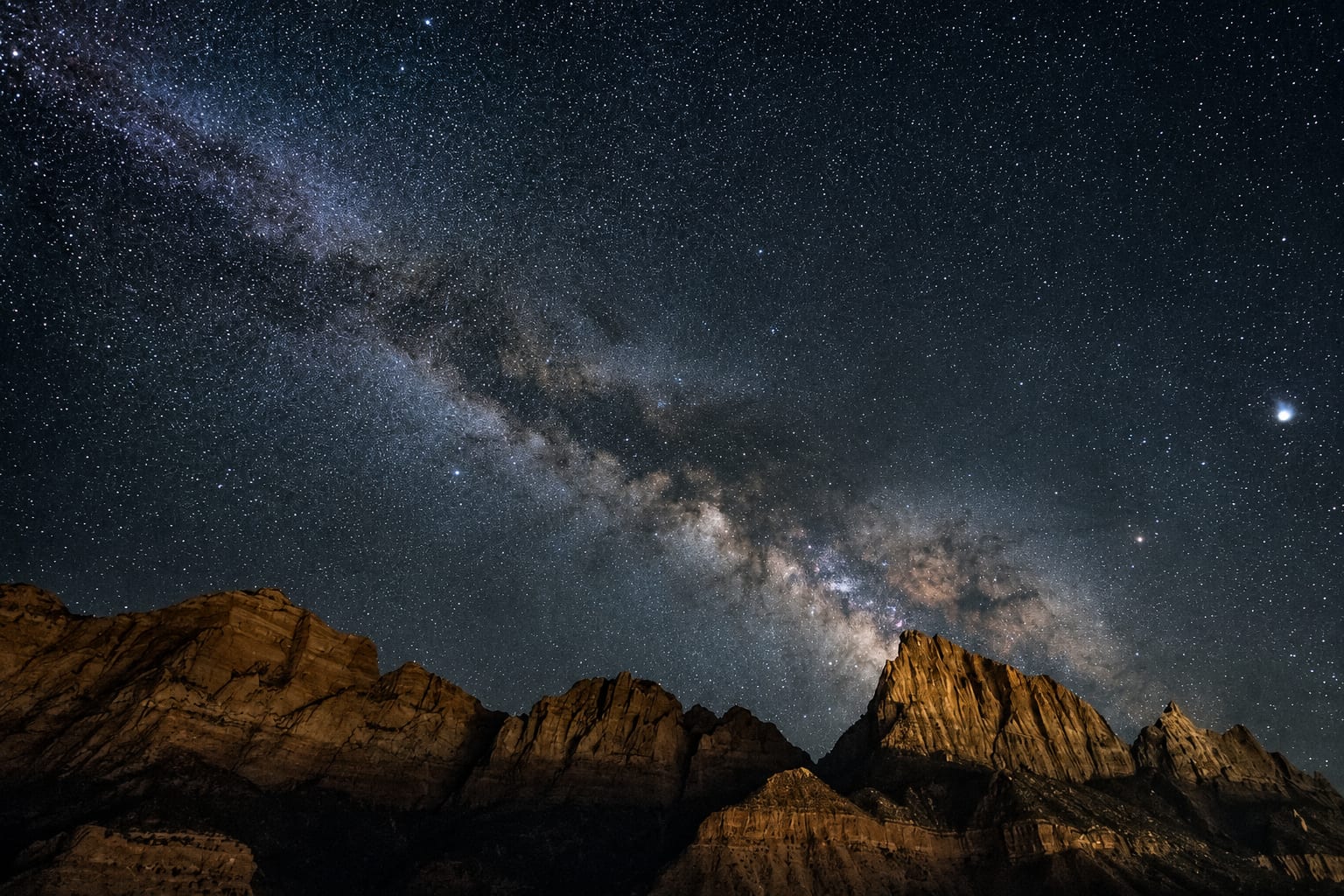
The sky doesn't just have stars; it has structure. Dark lanes split the galactic core. Star clouds pile up in Sagittarius. The whole band casts a faint glow across the red sandstone walls below.
Zion was the last of Utah's Mighty Five to earn International Dark Sky Park certification, in June 2021 — and what makes it stand out isn't just the darkness. It's the combination: Bortle 2 skies above 2,000-foot Navajo Sandstone walls. There's nothing else like it in the Southwest.
This guide covers the three best shooting locations, exact Nikon Z6II settings, and a full 2026 Milky Way calendar.
📋 For trail info, seasonal strategy, and trip logistics, see the Zion National Park Complete Guide. This article is purely about the night sky.
Dark Sky Data
Zion National Park holds a Bortle Class 2–3 rating, as measured by VIIRS satellite data at park coordinates. The park was certified as an International Dark Sky Park by DarkSky International on June 3, 2021 — the last of Utah's Mighty Five national parks to earn this designation. Springdale, the gateway town, is also a certified International Dark Sky Community.
Bortle Class: 2–3 (Lava Point hits Class 2; main canyon floor Class 3)
Sky Quality: ~21.7–22.1 mag/arcsec² (Lava Point highest)
DarkSky Certification: International Dark Sky Park — certified June 3, 2021
Darkest Site: Lava Point Overlook (7,890 ft elevation, Kolob Terrace Road)
Light Pollution Direction: St. George (SW, ~40 miles); Las Vegas (WSW, ~160 miles); Cedar City (NNW, ~55 miles)
At Bortle 2, the dark rifts cutting through the galactic core are visible without any optical aid at all, and the sky itself has visible texture: brighter patches, darker lanes, the whole structure of the galaxy rendered overhead. Plan your shoot around this sky and you won't need heavy processing to make the Milky Way pop — it already does.
Milky Way Visibility Calendar
From Zion's latitude, the galactic core rises in the southeast after dark, swings through due south across the sky, and sets in the southwest before dawn. It peaks at roughly 30° above the southern horizon at its highest — not overhead — so you want a shooting position with a clear, unobstructed view south. That's worth knowing before you pick your location: south through southeast is your money direction.
Month | Core Visible | Best Window | Notes |
|---|---|---|---|
January | No | — | Core below horizon all night |
February | Pre-dawn only | 4–6 AM | Core rises in SE just before dawn; late Feb start |
March | Pre-dawn | 2–6 AM | Window expanding; cold but usable |
April | Late night/pre-dawn | 1–5 AM | Core rises higher; shoulder season begins |
May | Evening–pre-dawn | 10 PM–4 AM | First full evening window; arch visible |
June | All night | 9 PM–4 AM | Prime time begins; long dark window |
July | All night | 9 PM–3 AM | Best month: core highest, longest window |
August | Evening–late night | 9 PM–2 AM | Still excellent; add Perseid meteor shower Aug 12 |
September | Evening | 8–11 PM | Window shrinking; golden hour + Milky Way combo |
October | Brief evening | 7–9 PM | Core low and setting fast; season end |
November | No | — | Core sets before astronomical dark |
December | No | — | Core below horizon |
2026 new moon dates for peak months:
June 14 (window: June 10–18)
July 14 (window: July 10–18)
August 12 (window: Aug 8–16) — new moon coincides with Perseid meteor shower peak; best single week of 2026
Here's the framing advantage you'll want to keep in mind: shooting toward the south and southeast puts you directly into the cleanest part of Zion's sky. St. George's light dome sits to the southwest, Las Vegas far to the west-southwest, and Cedar City to the north-northwest — so when you point your lens toward the galactic core, you're looking away from all three. That's not luck; that's geography working in your favor.
Best Shooting Locations
1. Lava Point Overlook
Lava Point Overlook is the darkest road-accessible spot in Zion and one of the darkest in all of Utah — this is where you go when you want the best sky the park can offer. You'll reach it via Kolob Terrace Road, about 25 miles north of Virgin, UT; the last stretch is unpaved but manageable for a 2WD vehicle with reasonable clearance, just go slow. At 7,890 feet of elevation, you're above the slight haze that can settle in the valley, and the elevated position opens up a southern horizon framed by the Kolob Fingers and the West Temple as natural silhouettes. Plan to arrive before astronomical dark to compose your shot, bring your own water and supplies since there are no restrooms, and note that the road closes in winter — your window is roughly May through September. The NPS officially lists Lava Point as one of three recommended telescope setup sites in the park, so you'll sometimes have company from other photographers and astronomers, but there's room to spread out.
2. Checkerboard Mesa Pullout (East Side)
If you want the most striking foreground in the park — and arguably in the Southwest — head to the Checkerboard Mesa pullout on the east entrance road, Hwy 9. The cross-hatched face of the mesa creates a geometric, almost architectural foreground that reads beautifully against the galactic arch in a wide-angle frame — it's the kind of composition you won't find duplicated anywhere else. Pullout spaces along Hwy 9 accommodate a few vehicles, the southern horizon is largely open, and there are no facilities, so pack accordingly. The key advantage of the east side: Springdale's ambient glow sits to the west, well behind you when you're shooting south toward the core, so you don't have light bleed competing with your foreground.
3. Timber Creek Parking Lot (Kolob Canyons)
If you're coming from I-15 or staying anywhere near Cedar City, Timber Creek is your best and most accessible option — and it's the only one of the three with restrooms. Drive to the end of Kolob Canyons Road from I-15 exit 40, about five miles in, and you'll arrive at a paved parking lot with solid southern and western horizons framed by the towering finger canyon walls. The Kolob Canyons section sits 45 minutes from the main park entrance, and there's no nearby town pushing light into the southern sky — so what you get here is genuinely dark, clean, and easy to access even in the middle of the night. The NPS lists this as a recommended telescope setup site, and the paved surface makes tripod placement straightforward on any terrain.
Nikon Z6II Settings
The Z6II is one of the best stock cameras you can bring to a Bortle 2 sky. Its full-frame sensor handles ISO 3200 cleanly at f/2.8, so you can get publishable results without hardware modifications, and at Bortle 2–3 you don't need to push exposure nearly as hard as you would in a light-polluted location. Before you dial in your settings, memorize the 500-rule: divide 500 by your focal length to get your maximum shutter speed in seconds before stars start trailing. At 14mm that's about 35 seconds — but use 20–25 seconds for sharper stars on the Z6II's high-resolution sensor.
Scenario | ISO | Aperture | Shutter | White Balance | Lens |
|---|---|---|---|---|---|
Milky Way Wide Field | 3200 | f/2.8 | 20–25s (at 14mm) | 3800–4000K | NIKKOR Z 14-24mm f/2.8 S @ 14mm |
Star Trails (interval stack) | 800–1600 | f/2.8 | 30s × 200–400 frames | 3800K fixed | NIKKOR Z 14-24mm f/2.8 S |
Moon + Landscape | 400–800 | f/2.8–f/4 | 1/125s–1s (blend) | 4500–5000K | NIKKOR Z 24-70mm f/2.8 S |
Z6II-specific tips:
Long Exposure NR: OFF. It doubles your wait time between shots by shooting a dark frame in-camera; handle noise reduction in post with dedicated dark frames instead.
IBIS/VR: OFF on tripod. VR can introduce micro-vibration during long exposures when the camera isn't moving; turn it off as soon as the tripod goes down.
Focus: manual, 10× Live View on a bright star. Autofocus hunts and fails on stars; zoom all the way in on a bright star in Live View, adjust manually until you see a clean pinpoint, then lock the focus ring.
Release: 2-second self-timer or remote shutter. Any camera shake from pressing the shutter button will smear your stars; use one or the other every single shot.
Foreground blending. Expose one frame for the sky (ISO 3200, 25s) and one for the foreground (ISO 800–1600, 30–60s during blue hour), then blend the two in Lightroom or Photoshop for clean detail in both zones.
NPS policy: no light painting on rock formations. Zion explicitly prohibits shining any light on canyon walls or formations; keep your lighting on your gear and your path only, never on the sandstone.
What to Photograph (Deep Sky Objects)
Three targets that'll reward you on any clear July night at Zion — and at Bortle 2, you can actually see all of them without binoculars.
The Lagoon Nebula hangs just above the Sagittarius Teapot, and at Bortle 2 you can spot it as a soft, glowing smudge with the naked eye — something that simply doesn't happen in most of the places photographers shoot. In binoculars it blooms into a luminous cloud split down the middle by a dark dust lane, and a 14mm exposure of 25 seconds will pick up a distinct pinkish glow in the frame.
The Great Hercules Cluster rides nearly directly overhead in July, which means you can frame it against the dark sky without any foreground obstruction. Naked-eye it's a tiny fuzzy dot; in binoculars it becomes a cotton-ball smudge that starts to resolve into individual stars around the edges — one of those targets that rewards you more the longer you stare.
The Milky Way's Great Rift is the dark split running down the center of the galactic band, and at Bortle 2 it's the detail that stops first-timers dead in their tracks. It's not just a bright arc — it's a structured, textured river of light with a visible dark lane running through it, and your camera will render it in a way that genuinely surprises even experienced photographers the first time they see it here.
Ranger Programs & Astronomy Events
The NPS runs ranger-led night sky programs at Zion from May through September — 30-minute talks with telescope viewing and constellation tours led by interpretive rangers. The primary location is the South Campground Amphitheater, with additional programs sometimes scheduled at the Human History Museum. Check the NPS Ranger-Led Activities page for current schedules, as program nights can shift week to week.
For private guided tours, Stargazing Zion operates out of Lambs Knoll above Virgin, UT (about 15 minutes up the mountain from the town) and offers small-group sessions with telescopes provided. Their guides have astronomy degrees and run educational tours rather than astrophotography workshops. Worth booking if you want a local expert walking you through the sky on your first visit. Note: it's genuinely cold up there even in July — temps in the 50s°F regardless of valley conditions — so dress for it.
Gear for Astrophotography at This Park
Zion's desert climate means cold nights even in summer — temps at Lava Point can drop into the low 40s°F in July. The distance from trailheads to dark spots and the total lack of facilities at Lava Point make gear selection practical, not aspirational.
Petzl Tikka CORE headlamp — required at every shooting location. NPS prohibits white lights near rock formations after dark, and red light protects your night vision (and other photographers' exposures). The Tikka CORE's 450-lumen output handles the unpaved road approach to Lava Point, and the dedicated red mode is one button press away. Rechargeable via USB so you're not buying batteries before every trip.
Nikon EN-EL15c batteries (2-pack) — cold desert nights drain lithium batteries faster than you expect. A Z6II battery can die in 90 minutes at Lava Point in May or September when temps drop into the 30s. The EN-EL15c is the Z6II's native battery — third-party clones often don't hold charge in cold. Buy the 2-pack and keep one in an inside jacket pocket against your body to maintain warmth.
Manfrotto Befree Advanced tripod — wind picks up at Lava Point's exposed ridge position, and a lightweight travel tripod will vibrate during 25-second exposures. The Befree Advanced packs down to under 16 inches for travel but extends to full height with a stable ball head — the lever-lock legs deploy faster than twist-locks when you're racing dusk. Aluminum keeps the weight realistic for hiking in to dark spots. Hang your camera bag from the center column for extra stability when wind kicks up.
JJC wireless intervalometer remote — pressing the shutter button directly transmits vibration that smears stars in 25-second exposures. The JJC is Z6II-compatible and adds something the wired Nikon MC-DC2 doesn't: programmable intervals for star trails (200–400 frame sequences without standing at the camera) and built-in time-lapse mode. Wireless triggering also means you're not tethered to the tripod in cold wind.
PhotoPills — iOS/Android app for planning the exact Milky Way arc position over Checkerboard Mesa using AR mode. Essential for pre-visualizing composition before you drive to the location. Pair with the free Stellarium app for object identification and shooting window calculations.
Warm layers — more than you think. Lava Point at 7,890 ft gets cold fast after sunset, and a 70°F valley afternoon will drop to 40°F by midnight up there. Pack a puffy jacket and insulated pants even in July. Not a gear purchase — just a packing reminder.
Frequently Asked Questions
What Bortle class is Zion National Park?
Bortle 2–3, depending on where you're shooting. Lava Point Overlook reaches the darkest Class 2 designation; the main canyon floor sits at Class 3 due to Springdale's light dome to the south. Either end of the range is exceptional. Zion was designated an International Dark Sky Park by DarkSky International on June 3, 2021.
What's the best month to photograph the Milky Way at Zion?
July is your best single month — the galactic core is at its highest point in the southern sky, the dark window runs from roughly 9 PM to 3 AM, and the 2026 new moon falls on July 14, giving you a full week of prime shooting centered on the 10th through the 18th. August is a close second and adds the Perseid meteor shower on the 12th, which in 2026 coincides almost exactly with the new moon — the best single week of the year for Zion astrophotography.
What are the best Nikon Z6II settings for Milky Way at Zion?
Start at ISO 3200, f/2.8, 20–25 seconds at 14mm on the NIKKOR Z 14-24mm f/2.8 S. Set white balance to 3800–4000K (not Auto), switch Long Exposure NR off, and turn IBIS off once you're on a tripod. Focus manually using 10× Live View on a bright star, then lock the focus ring.
Where is the darkest spot in Zion National Park for astrophotography?
Lava Point Overlook is the darkest accessible location in the park, sitting at 7,890 feet on Kolob Terrace Road, about 25 miles north of Virgin, UT. It reaches Bortle Class 2 and is one of three NPS-recommended telescope setup sites in Zion. The road is unpaved near the end but passable in 2WD with clearance; it's open roughly May through September.
How much does moon phase affect Zion astrophotography?
Moon phase is the single biggest factor in whether you'll get a usable Milky Way shot — even a half moon brightens the sky enough to wash out the galactic structure. Aim for the five nights on either side of the new moon for the best darkness. A full moon isn't wasted though: it makes for stunning landscape shots of the canyon walls lit in natural silver light.
🌌 Want updates when the next astrophotography guide drops? TrailVerse publishes new park-specific astrophotography guides through the 2026 Milky Way season. Subscribe to get them in your inbox.
🗺️ Planning your trip? TrailVerse's AI trip planner builds custom itineraries based on your dates, interests, and pace.
Keep reading
More on this topic from TrailVerse